In a conventional educational setting, it can be hard to see how ideas and skills actually apply to life beyond school. There are certainly exceptions, and many of our classroom-based colleagues lean in–against significant headwinds–to build the connection between a school’s “curriculum” and the real world. If you ask students though, they’re clear that much of school feels disconnected from life.
As a young person who spends their hours in a school building, it’s natural to wonder, “What do people actually do out there?” Many students have jobs, of course, but these are often entry-level positions: clerical, retail, washing dishes. Few have the opportunity to explore how the world of business actually works. The Burlington City & Lake Semester is grateful to have an ongoing relationship with HULA Lakeside, which helps us offer a crash course in entrepreneurship and social change.
According to its website, HULA “elevates Vermont entrepreneurs and start-ups and creates community connections from a 14-acre coworking campus, venture capital fund, and business incubator…along the shores of Lake Champlain.” This innovative community is a perfect place for a semi-annual residency. Along with meeting inspiring game-changers, students reflect on what skill-sets and mindsets help a business succeed, while adhering to its values and leaving the world a better place.


Our HULA days were packed. We met with Myti, Glavel, 1% for the Planet, Next Generation, and Plink! (It’s helpful to meet with Plink! last, if only because their exclamation point helps end the sentence.) Each session offered a window into how the organization approaches its work, and what values it follows as its North Star.

I think Myti is interesting because they chose to face one of the biggest companies in the world directly and try to jump in a market that doesn’t have much room or need for new businesses.
– Dylan
Myti was my favorite business out of all of them, because they really emphasized giving back to the community, especially Burlington. This is important because downtown is not fun anymore. We don’t have even have a mall anymore, and Myti talking about keeping money in the community so that we can have better stuff.
– Ahmed

I think it was really cool how Glavel is making gravel out of glass and that a lot of projects in burlington are now using Glavel. I also thought it was really cool how they got the idea for making that.
– Tobey

The 1% company was interesting. Learning about how there’s a company out there that takes 1% of revenue and donates the money to a nonprofit eco friendly organization.
– Zeke
I love how big yet small 1% for the Planet is. They are big in that they are supported by a bunch of companies, yet they are small because they hone in on the wants and needs of each individual company.
– Rory
I think the 1% work is really inspiring because these companies that leave a carbon footprint can at least give back 1 percent.
– Hilolwe

I thought Next Generation was interesting mostly because of Marlon. I enjoyed how he engaged with us and how he talked about his work. He has done so many things with his life and has engaged with his surroundings in so many different ways it was fun to hear. I also resonate with his idea of the importance of story-telling. It can tell a lot about a person and you get a view into their perspective of things that happen around them.
– Layla
Marlon Fisher was a really interesting person. He really values honesty, integrity and finding your people and community and it’s impressive how he finds time to be so present for his kids when he has so many different things going on. This man could drop some serious dad lore. It was so cool that he is part of the moth because I had just listened to the most amazing episode and he’s a standup comedian AND dismantled terrorist groups!
– Helen


Plink was really interesting to me. They opened my eyes to how plastic bottles really effect the world and the places we live in. it made me think I should always rethink before I buy anything that is a plastic bottle. I also feel bad because I feel as if I had some part in why the world is this way and how many bottles are floating in the water
– Bahja
Plink is very interesting and a good idea. We need to save our planet and our ocean. Why is plastic getting dumped there? It’s sad, and I’m glad there’s a business in our community spreading awareness and also making a change by promoting this project.
– Fataiya
We also discovered that HULA itself is a space we can learn from. The campus is also designed to support seemingly opposing polarities, including freedom and connection, reflection and innovation, and ease and engagement. It feels so different from BHS, which was designed functionally, instead of backwards from values.
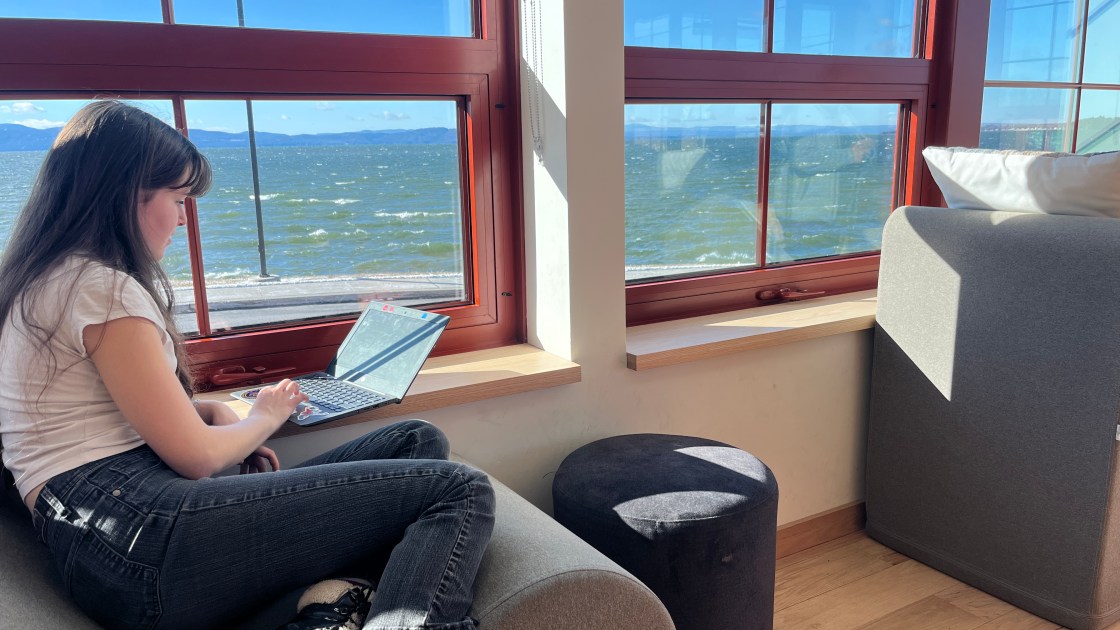
How could we spend a few days there and take advantage of HULA as a workspace? Students fanned out across the campus and got right to work. Before sending them off, Dov told them to “work like you’re paying for the time.” BCL12 students didn’t disappoint.


As if our week wasn’t full of enough powerful, world-changing business partners, we capped it off with a morning at Beta Technologies, a firm that is reimagining–and redesigning–air travel for a post-carbon world. Students toured the workspace, walked the hangar, and tried their hand in the flight simulator. Similar to our partners at HULA, our time at Beta was inspiring.


After our time at HULA and Beta, students were asked to reflect on all of the businesses we had met with. One of our final questions was “What is most powerful change lever we’ve seen?” Their answers span from strategic to values-driven.
- Make more connections
- Make yourself known
- Save the Earth
- Treat everyone well, and then treat the planet well too
- Adapt and expand
- Have a productive work space
- Be interesting
- Help both people and the environment
- Better the world
- Spread awareness
- Care about how your carry yourself, and how the community sees you
- Start a positive chain reaction
- Raise awareness
- Help people want to make change

 Burlington City & Lake Semester