
As every BCL alumni knows, our essential question is What does it take for a community to thrive? With the city as our classroom, it’s easy to focus on societal systems, the human-designed elements of Burlington. Housing, energy, transportation, politics, justice, and the economy are all around us. This curriculum is close at hand. As soon as you see it, you begin to see it everywhere.
But there’s another system that is actually the foundation for everything else we study — the natural system. Similar to other systems, it is complex, which is why we are grateful to community partners who act as guides and interpreters. We are also grateful to Burlington’s geography. After all, it isn’t every city that has 50% of its land as green, open, or undeveloped space.
However even though the natural world is easily accessible, that doesn’t mean that everyone’s sense of place is similar. Some of us routinely enjoy the city’s water, fields, woods and trails; others spend their time in the built environment, and rarely venture out into the urban wilds.
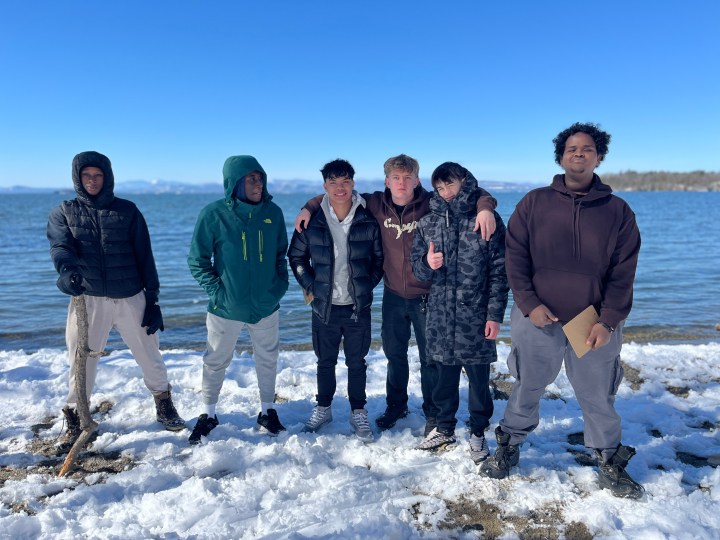
In BCL, we often talk about the importance of relationship. In a human context, we can’t have empathy for those we don’t care about, and we don’t care about those we don’t have a relationship with. The same is true of the natural world. In order to steward a place, you need to care for it, and that care can only come from being in relationship. You can’t protect something you don’t love, and you can’t love a place you don’t know. It’s essential to get out into nature, to explore, and take it in.


The walk we had at Kieslich park was very refreshing. I felt more aware of my surroundings, and connected to nature. Ideally you would never see me going to a park in the winter walking in the cold, but it was nice to step out of my comfort zone.
I had interesting talks with my friends on the bike path and had some good laughs. That got me thinking that regular school nowadays is strictly based on academics and doesn’t really focus on how to connect with others and our environments. Maybe that’s why a lot of students don’t thrive in school settings. 10 years from now I’m not going to be thinking of that science test I took or that article I read, however I’m more likely to remember the field trips I’ve been on or things that are community based such as programs that are similar to BCL.
When I’m in school it’s super easy for me to just ignore everyone and be in my own bubble, but when I’m at BCL I don’t really have the choice of isolation. A lot of the things we do our based on connecting with people and stepping out of our comfort zone which I think is a great thing.
- Ifrah



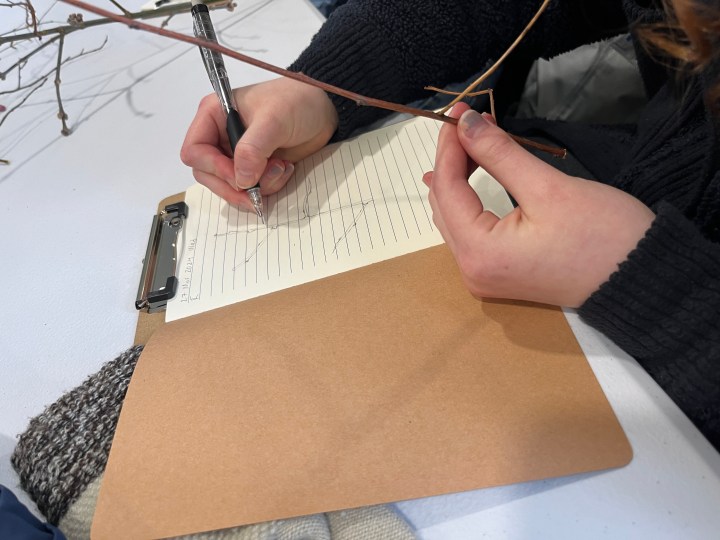

Having explored nature in our own backyard, we were ready to go further afield. When BCL12 was invited by our “cousin program,” The Walden Project, to experience their unique approach to learning, we jumped at the chance. Like BCL, Walden is truly place-based, taking advantage of their unique setting to create the conditions for learning that they could only experience there.
After a short drive, we were there. BCL students weren’t sure what they were getting into. You couldn’t even see the campus from the gravel parking lot. (“We have to walk there?”) Yep. We have to walk there.


It was really fun and exciting to be out in the woods and wilderness. It was really nice and peaceful. It was soothing and very quiet out in the woods. People need to go out in the world more and always go out into nature. Always be outside and out in the world.
– Riley
I liked it a lot and it was fun not being inside. I really liked how they cook their food by the fire and how outdoorsy they are. I think spending time outside for a bit will really make you appreciate nature.
– Zeke
I feel really connected to the natural world because sometimes you just need a place where you can not be distracted and just spend some time, as in listening to your breathing/body. Still, I don’t think I would have a class in the woods year around. That’s not my type of thing. I like big cities and big towns. I just would not feel comfortable at all times staying in the woods and telling myself this is my class.
– Mustafa
I thought it was interesting having a class where it’s not actually in a room and more outdoors. It felt a bit calming and nice to have some fresh air all day while learning about your surroundings. For me, sitting down and just taking it in helps to feel a bit more connected.
– Kylee
What gets in the way of nature connection? Stress. When we have other things on our minds. we can’t fully be present in the moment and conversation when there is something “more important” for us to focus on. At Walden, it was so peaceful, all the sounds and scents. It didn’t even really feel like a school day because it felt like I chose to be there. Being in places where we feel comfortable. I feel like I can build deeper connections when I am not being stressed out by a project or environment. I was able to stay fairly focused.
– Rory


Being at Walden was really different, especially learning in the woods. I definitely like school in a building better but it was nice to mix things up a little bit and go to Walden to learn.
– Caleb
Spending time there was really cool and unique, but it just wasn’t for me. This doesn’t mean that I don’t feel connected to the natural world. I still love going to the beach and hanging out in parks, it’s just something about being in the woods… I talked with one of the Walden students, and he was talking about how he’s a blacksmith and he even showed us his little workshop there and I found that really fascinating.
– Tobey
Being In the natural world is the only way to understand the natural world because I feel like there is a lot that can’t be explained and just has to be experienced. I like the fact that they are outside in the woods and connecting with the outside life, even going as far as eating on wooden logs, which I thought was weird but is sorta primal, and shows their connection with the woods.
– Ahmed
I like to stop and notice the tree branches and details of plants, which makes me feel more grounded. It’s important to spent time in nature and the more you spend time in the same natural place the greater your connection is to it. I really enjoyed being able to go into their woods and hear about the way they learn and have school here. The smoke was always getting in my eyes but I loved the fire and the stew even more! I’ve had food cooked over a campfire only a few times before and it always makes me feel more connected to the land. I also love to be among the trees.
– Helen
When I think about what gets in the way of connecting to nature, the main thing for me is bugs! I don’t do bugs. I hate em… I’d rather be at home as well, because that’s my safe and comfortable space. If I feel as if I’m not comfortable somewhere, I won’t be there so that’s why it’s difficult for me to feel connected to nature.
– Bahja
I really enjoyed being outside, around the fire, being with the experts of that space. I’m glad that the Walden students were there to show us around and help us feel comfortable in the space. Their presence and energy was very welcoming and I was able to connect with some people and talk about the similarities of our experiences and classes. It was also very calming being there and I felt more in the present. Being out there felt like nothing else was going on in the world.
What helps with that sense of connection? Just being out and being uncomfortable. Part of it is pushing your boundaries… Being out there and starting to become aware and comfortable with your surroundings can help you start to feel connected. Also just finding your space. It may be in the woods, it may be in a field, it may be at the beach. Once you are present in where you are, you start to notice the small things and be more comfortable.
– Layla
BCL couldn’t exist without Shelburne Farms. It’s a deep symbiosis that began nearly seven years ago, and continues to help BCL thrive. Every time we bring students to the farm, it’s a programmatic homecoming. It’s also a blast.
Thanks to a unique partnership between Shelburne Farms, UVM’s Place-Based Education program, and the Burlington School District, this year was the first in which we’ve had a fifth-year Teaching Fellow on staff. It felt natural for Ivy to be our host. In the morning, she facilitated a variety of place-connection games at the farm’s outdoor classroom. In the afternoon, Shelburne Farms colleagues Aimee Østensen and Joan Haley facilitated a climate fresk. Each element of our day at the farm added up to more than the sum of their parts. We left feeling energized, connected, and aware.


Ivy Befeler, BCL’s Teaching Fellow, designed our day at the farm. Her reflections on the day identify how intense it is to face down a crisis. “Connecting our morning of fun and playful exploration in the outdoor world to the afternoon of heavy but real issues happening in our global community bridges the gap between abstract concepts and real-world challenges. For many, the Fresk brought up uncomfortable feelings, due to the urgency and apparent hopelessness of the climate crisis. However, addressing it as a class and shifting our focus as a cohort to actionable steps we can take in the Burlington community helped boost our morale.”
Doing the fresk opened my eyes more to the bigger problem. We all have to play our part to fix our planet.
– Caleb
We need to bring people together. If we bring people together, then we can help others want to change, not just for themselves but for others and the world .
- Ahmed
It really helped me think about climate change and help me really think about where I come from and help me care about the world that I live in.
- Khamis
The climate fresk thing was a fun way to learn more about climate change. I feel like Amy did a good job at getting everyone to participate and think. My takeaway was to help make a better future I have to change myself for the better and get more in touch with the world.
– Ifrah


What we need is people that care, as in people caring about it now rather than later.
– Mustafa
In the beginning I was kinda confused and wasn’t sure what was going on. But the more we continued to talk and get the cards the more I started understanding and the conversations went pretty well. My conclusion? Don’t be like Dov’s generation.
– Bahja
When we were asked to draw the future world we wanted, I drew some buff sheep and cows to symbolize strengthening nature. I also draw a seed growing into a tree and two people holding hands to show the importance of social justice in solving climate change.
– Helen
Helen drew a buff sheep. I drew an image of Human Decency on my paper. if we all just be kind to each other then the world might just become better.
– Kylee
To put the finishing touches on our exploration of our natural system, students reconnected with Burlington Wildways, who in partnership with the city’s Parks, Recreation, and Waterfront department and the Burlington School District, are engaged in a variety of projects to promote climate resilience, education, and multi-generational stewardship on the campuses of Burlington’s schools.
It was fun to see Zoe, Braden, Quynh, and Sam, who at this point feel like old friends. But this time, we weren’t just exploring. We were also there to get our hands dirty. After all, there is nothing like a sense of shared purpose to bring people together.


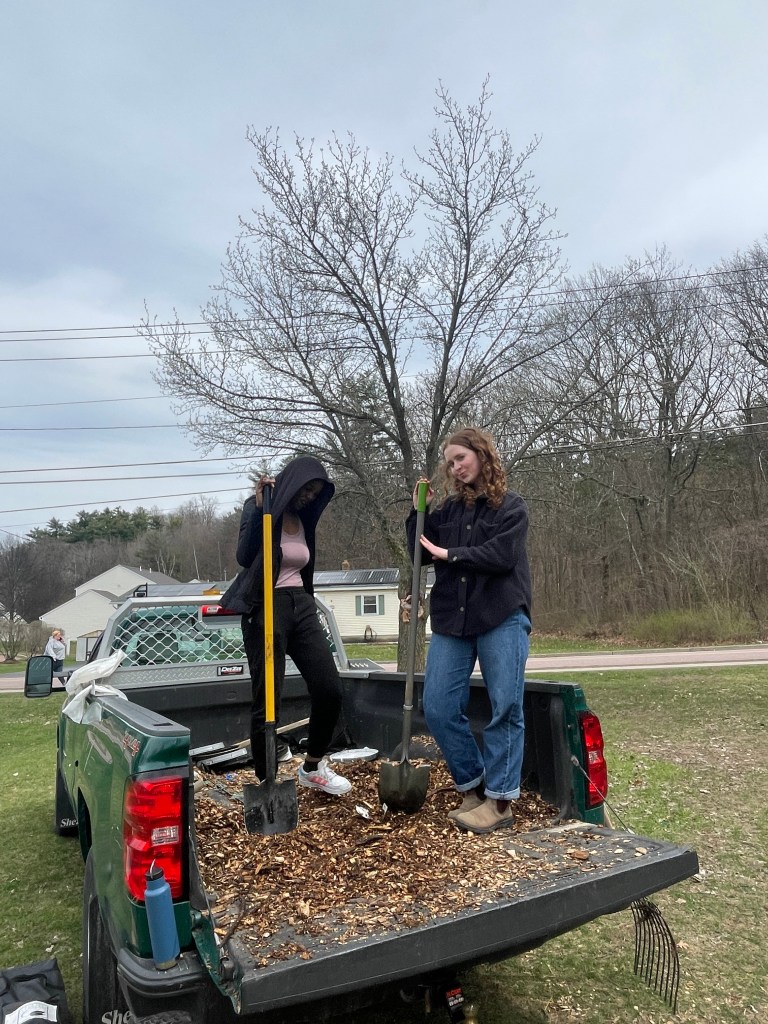
I felt good and had fun planting the trees with the kids. I think they look up to us as inspiration. One thing I thought about the whole time was “These poor kids have to deal with generations of damage to our world, and they are going to have to fight it”. I think that it is not fair to these kids that they have to deal with generations of damage done to the Earth. They and the other kids below them will have to fight climate change the most I think. This is no easy task. I also thought about how the kids did not know much about what is happening in our harsh world, and that the generations above them, including my generation, are not thinking about what they will have to deal with. I came up with a question. What can I do to make these kids’ lives easier and better when they are my age?
- Semin


 Burlington City & Lake Semester