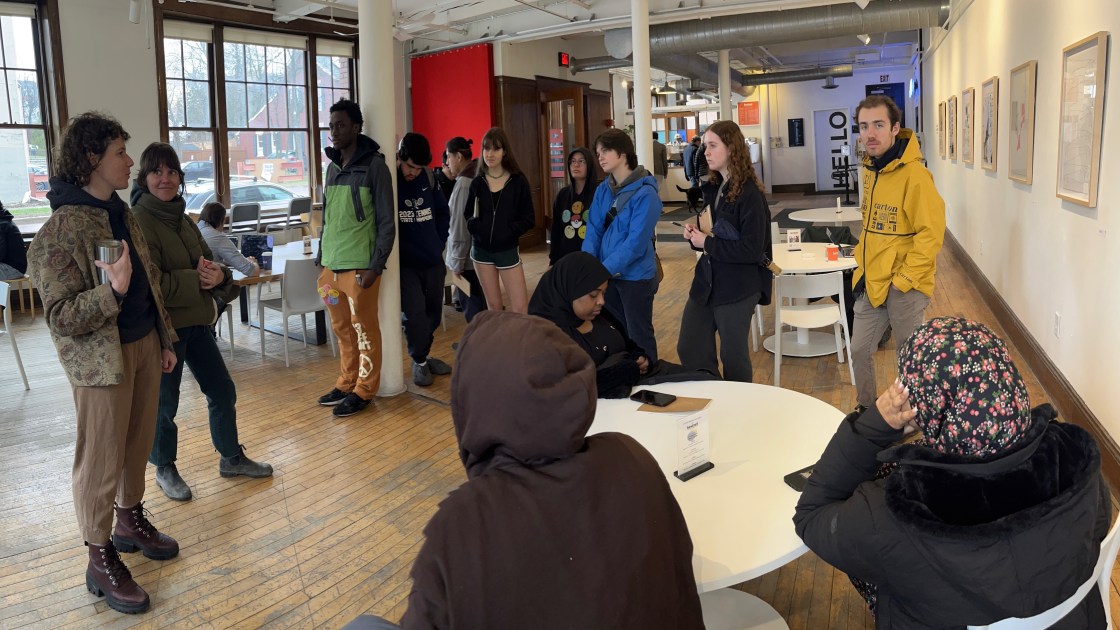
From its inception, BCL has always been a learning space for anyone who is interested in Place-Based Education. We regularly host visitors from other schools, other states, and even other countries – educators, neighbors, community partners, leaders, artists, anyone who is interested in what BCL is all about.
We also fold in early-career professionals. Over the past two years, we’ve integrated ECO Americorps, Teaching Fellows, and most recently, our first student teacher, Andrew Banno. Opening the program to young people honing their craft is a way of “teaching it forward.”
We first met Andrew when BCL collaborated with the UVM Place-based Education certificate program during the Fall of 2022. At the time, Andrew expressed interest in going deeper and joining the team in Spring 2024 for his student-teaching internship. Now that Andrew is on the cusp of graduation, it feels like a good time to share a few of Andrew’s reflections about his experience at BCL and the Place-Based Education program as a whole.

I was able to advocate and land myself the opportunity to spend half of my time at Burlington High School, a traditional high school environment, and the other half at Burlington City & Lake. At BHS, I joined a class that was already underway. As a semester program, every student arrives at BCL on day one with the same opportunity and experience. Being a student teacher, it was also nice to have a program that was new for everyone, allowing me to be part of the relationship building experience from the very beginning.

The program is incredibly diverse. As a result of such different lived experiences and representation, every student brings their own unique opinions and ideas to the group, making it such a vibrant, rich learning experience.
One of the first things that was apparent when stepping into BCL was the emphasis on forming community the first few weeks. An important element is doing ice-breakers, team games, and activities that build community. If you set up the conditions before hand that allow students to build trust in one another and feel accepted for being themselves, every learning experience from then on can be so much more impactful. Discussions and learning can go to places that are deep, authentic and meaningful for students because trust and community has already been built.

The overall structure of BCL’s place-based program began with students being introduced to the Old North End Community Center and then quickly transitioned into learning how to thrive as individuals, thrive as a group, thrive as a city, and then thrive as a planet.


There were a handful of activities that continually happened throughout the semester – and in my eyes were transformative for the group of students at BCL. These activities included Circle, Fun Block, Making Learning Visible, and Expo/Inquiry Projects.
All of these activities revolved around forming a community, asking big picture questions about systems in the city of Burlington, and tied into direct experiences that we were having throughout our days at BCL. This made the learning and discussion feel extremely applicable for students. One of my jobs throughout my time at BCL was to actively facilitate, asking follow up questions that invite students to go deeper, or explain their opinion. Sometimes, I added my own thoughts, but most of the time I tried to allow students to make their own discoveries by generating more questions that allowed students to come to conclusions that they didn’t realize they were capable of producing.

Research tells us that direct experience is one of the best ways to change attitudes and mindsets. With the sheer amount of diverse community partners that BCL uses, students have the opportunity to learn from experts in their particular field, see viable jobs in the future, and make connections with people in their own community. In traditional education, we learn about the window and mirror theory. The emphasis is on creating learning experiences that allow students to see representations of themselves reflected back, yet also having learning experiences that serve as a window, allowing students to see experiences that are different than their own. Through place-based education, I have come to realize that the window and mirror theory is only able to go so far. Burlington City & Lake semester uses a different equation: Direct experience doing an activity + connection with a community partner = meaningful learning experiences for students.

Through place-based education, students are able to get “outside the frame of language and into the thing itself.” They are able to meet community partners that share similarities or differences to their own identity. They are able to develop connections to different places in their community by having direct experiences in them. This allows them to be DOING rather than seeing. As a result, the learning feels authentic. It works to create leaders. It builds lifelong traits that young adults will need: resilience, curiosity, effective communication, collaboration. It invests in social-emotional learning. It provides confirmation of how to be a caring individual who contributes to this world and pushes the needle in a positive direction.
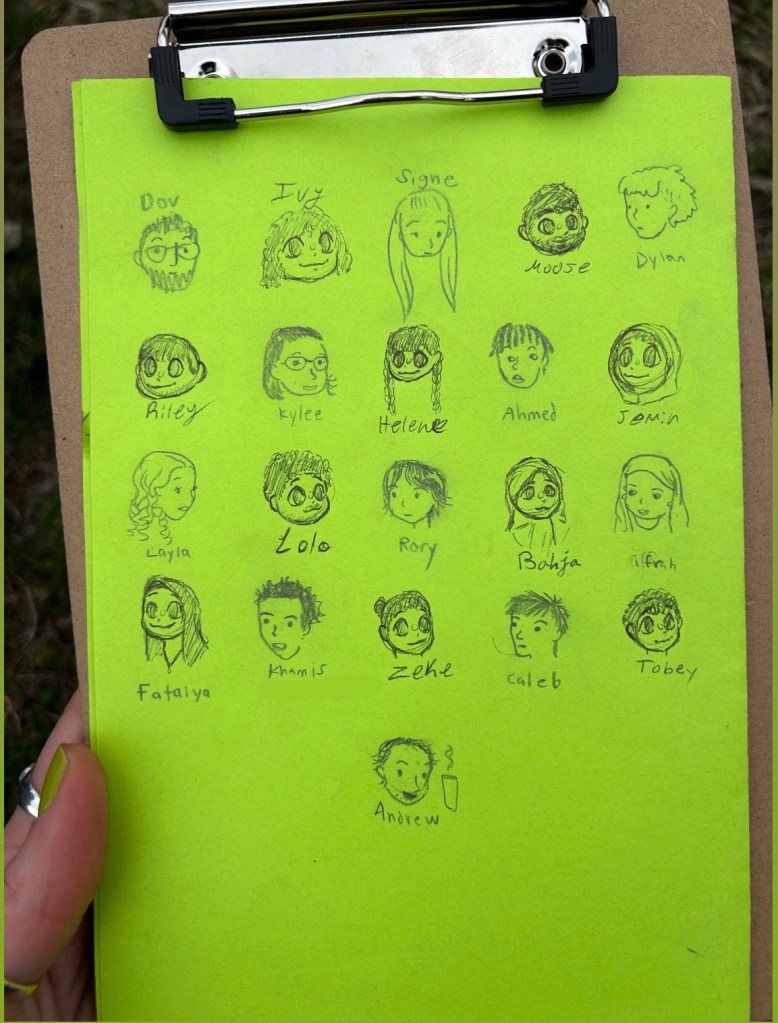
On Andrew’s last day, BCL12 students had a surprise for him: a card illustrating each member of the BCL community. What better way to remember everyone?

 Burlington City & Lake Semester