
The early days of each semester are filled with community-building and place-making. By mid-September, the air has begun to cool. A new season has arrived, and we’re ready to go deeper. This means engaging with community partners – professionals who are actively facing real-world challenges every day. It would be easy to organize these visits like a superficial field trip, but Burlington City & Lake Semester students quickly learn that they can’t be passive tourists. Each encounter, each interaction, is rich with a new worldview. Our partners often share authentic dilemmas that they face in their work. Together, we grapple with ethical issues without easy answers, and students begin to see how complex systems function.
As students engage with community partners, they take notes in their journal. They ask incisive and generative questions. And they reflect on the accruing layers of context, and the shift in perspective that accompanies each “aha moment.” They identify the places where systems overlap and interact. And they come to understand that real-world problems don’t have simple answers.
In a conventional teaching and learning environment, the teacher delivers the curriculum, and students strive to show their knowledge and understanding. In BCL, demonstration of learning takes on a different form – and feels more like Russian nesting-dolls: BCL students use their collaborative experiences as source material for their journals; journals become source material for their Expos. (Later, at the end of each quarter, Expos become tributaries for students’ summative “Evidence-of-Learning Portfolios.”)
Expos are completed every two weeks. These are challenging assignments, because they are based on a core premise, one that students have heard BCL teachers say numerous times: “We know what we’ve taught, but we don’t know what you have learned.” This sounds simple, but it sets the stage for a profound reorientation. Instead of assessing how well students have taken in what was taught, Expos ask students to demonstrate what they themselves are taking away. The responsibility to share their learning is fully theirs.
Expos are an opportunity for students to interweave three elements: observations and connections from their BCL experiences, independent research from relevant and valid sources, and reflections on their own shifting worldviews. They require students to explain their thinking, explore new perspectives, and expand on new insights.
Students learn quickly that these are assignments that you can’t phone in. Expos require active engagement, applied curiosity, academic rigor, and deep self-awareness. In most semesters, students don’t hit their stride until the end of Quarter 1. For whatever reason, BCL13 students have hit the ground running. Will their writing become deeper, richer, and more resource-rich as the semester unfolds? Certainly. But students are already using their writing to shine a light on their learning. Full Expos span several pages – a far greater word count than a blog allows for – so what follows are excerpts, small windows into more expansive thinking.
Seeing a Complex System: Transportation


After our exploration, I realized I had a limited view of what transportation truly entails… As a high school student in Burlington, I’ve generally managed to get where I need to go without much trouble. During my elementary school years, I rode the city bus with little to no issues. I was fortunate; if the bus was running late, my parents could drive me. With a stop near my home and right in front of my school, I mistakenly thought our transportation system was quite successful, especially after the pandemic when bus fares were waived.
Although we are making strides towards a more successful transportation system in Burlington there is much improvement to come. A video about 8-80 Cities said, “The healthiest, wealthiest, most sustainable and vibrant communities in cities around the world are unique in many ways. But there is one factor above all others that these communities have in common: they are, nearly without fail, highly walkable places.” Burlington is definitely not the most walkable city. On our walk we observed many bumps in the sidewalk that would not be wheelchair accessible. We also saw a dad pushing a stroller and decided how long it took him to cross the street between Champlain and North Street. We found that he was only halfway across the intersection when the signal timer ran out.
- Jo
If a city is accessible for children and seniors everyone’s needs will be met in the middle. Our bus transportation system in Burlington is not accessible for 8 and 80 year olds. I don’t think a 8 year old should be riding the bus alone because of the fact that the hub is downtown and the routes require you to still walk to where you need to go, you can’t get dropped off at a specific place. This goes for 80 year olds as well, someone 80 years olds cannot walk very well or very far and to get to and from the bus that might acquire a great walking distance. It also may be hard for some 80 year olds to physically get on and ride the bus because of their mobility.
In Bogotá Colombia, every Sunday from 7am to 2pm motorized vehicles are banned from many roads. This allows people to walk, bike, skateboard, rollerblader and more on any road in the city. City Officials say this has caused safer moments on busy Sundays. This idea was formed by all the violence cars bring to cities whether its crashes or even just road rage. The founder of this no motor Sunday plan said “Our objective is to make civilians take over the city’s public space.” I think this is a great and creative way to build community and limit chaotic traffic on busy days. I think it really gives people a moment to take a step back and realize the place and community they are a part of. I feel like Burlington could really benefit from something like this. I think it could really build community and make it thrive.
- Belle


After watching What is a Walkable City?, we went into the neighborhood and looked at the sidewalks to see if it was safe. We also checked if the crosswalk had enough minutes to walk across it. We also made sure there were benches and made sure the cars weren’t speeding. And it was a very fun time. We talked about places that needed to be changed to make it safer for other people. It was good to have a chance to talk about what we should do in the city, and about how if this place was safe enough for the people who have a disability, or old people who are trying to cross the street… It’s hard for them to walk normally on the sidewalks.
This demonstrates how other places can help change the streets…A lot of people have ideas about helping one another, and helping the City of Burlington to make everything safer. I’m wondering if the BCL group could contact people about how unsafe it is to cross or walk down the street and they can make changes around me just by asking them for a quick change.
- Lazizi
Peggy took us down North Ave and had us noticing every little detail and/or problem about transportation or sidewalks etc. Something that I noticed that I didn’t think of before on our walk was how short of a time people have to get from one side of the street to the other using a crosswalk… We timed it, starting the timer when the walk sign turned light and then counted 4 seconds and it went straight to the flashing hand. 4 seconds later the flashing stopped and the opposing light turned green. A total of 8 seconds to get from one side of the street to the other side may seem easy for me but, what if I was an older person who walked with a cane? What if I was a parent who was pushing a stroller? What if I was carrying groceries to feed my family?
There was something that happened in real time that I can vividly remember. We were walking back to the O.N.E center and we came up to the same crosswalk that I talked about earlier. As we waited we noticed a three-wheeler type of car that was at the light, waiting for the light to turn green. There was a middle-aged person who was walking across the crosswalk and they were a little late so the blinking hand had appeared about halfway through their walk across the intersection. As the opposing light turned yellow, the three-wheeler started to rev up its engine and create these loud and obnoxious noises. These noises scared the person, and then sped away obnoxiously. We all stood there, jaws dropped and just disgusted about what this person had done.
- Quinn
Past, Present, Future: Reimagining the Waterfront
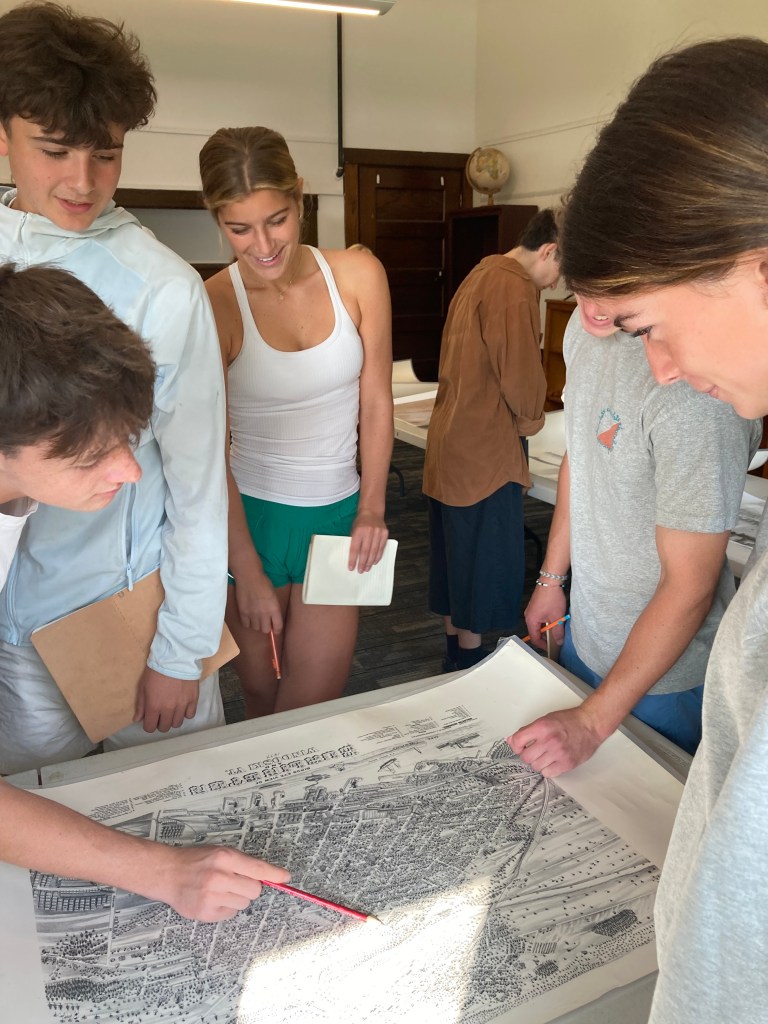


If we look at the old maps of Burlington’s Waterfront, we see toxic factories and brutal working conditions. We have changed for the better since then, so I aspire to change for the better once more. The Moran Plant is a place where we can create an aspirational goal that can cater towards all people. The waterfront is currently a paywall for those going out to dinner or those who own a boat. I really enjoyed the proposal for the ice rink in the winter, this is a brilliant idea to bring everyone together. In the summer I support the idea of an outdoor movie area. The spaces in between the foundation are the size of a traditional shipping container. They could put the containers in the missing blocks and use this as a source of the farmers market or the vintage market… … The colorful sight of the shipping containers would be very unique and special to Burlington, bringing more tourists and shoppers to the area.
- Gus
I admire Burlington and its past. I think it is so cool to learn about the history of where I live. One thing that really caught my attention, and I mean really, was the picture books of Burlington. I did not want to put the book down. Old photos fascinate me as I want to imagine myself in them and know what it felt like to live in such an industrial place like Burlington. One thing I thought was really cool, is the big houses that the rich built for themselves. I wrote down in my journal, “These houses have been around for so long, I grew up walking my dog past them and have always admired and been curious about who has lived there and what its past would have looked like.” Burlington used to not be the best place to live if you lived right on the water. Generally, that is where the poor lived. All the black toxic smoke would shoot up the sides of Burlington’s cliffs, and stain the houses right on the margins. This is why in the south end, the big houses are farther up in the hills. The rich could afford to live in the cleaner area, while the margins were for the poor.
Overall I think I would like to go deeper into Burlington’s past and see how it evolved. Writing this has actually made me want to take my dog up by UVM to just admire the old houses. I’m also surprised about the fact that I have never learned about Burlington being a lumber port before. Why are people not teaching this? I think it’s important to remember our past, so we can innovate and make Burlington a better place now.
- Annabelle


Learning about the history of the Boathouse with Erin Moreau was interesting to me because when I was looking through the book of historical pictures, something that I focused on was the old Boathouse, which used to be a yacht club and burnt down in 1903. It was then rebuilt and over time became more of a public place. Currently, the Boathouse has the restaurant Splash on one side and the other side is open to anyone to come and visit with amazing views of the lake and places to sit and relax.
A problem that Erin brought up was the fact that they didn’t have many visitors come to the boat house… Some solutions that we thought would bring more people to this community boat house include making a bigger sign for the Boathouse, and more advertisements that it is a public space welcome to all, not just people going to eat at Splash. Something else they could do is move the host stand so that it is not the first thing you are greeted by. Also if there are more signs up higher on land, Church Street, nearby restaurants, or any heavily populated areas, it can give more people the idea to go visit! I think that the Boathouse is a wonderful part of Burlington that should have more attention brought to it.
- Ruby
Today as I flipped through my journal I found a question that I had from our meeting with the Harbormaster, Erin Moreau… The Burlington Waterfront has one of the few public marinas in the U.S. This means that it’s completely open to the public to enjoy. Erin said, “It’s my job to make sure our community knows that they can come and enjoy this space whenever they want.” What I wrote down in my journal was, “Erin prides herself on making sure the waterfront is accessible to everyone, I think that awareness is an important part of spreading public information to everyone in need. Erin is very welcoming and understanding and it helps with public speaking and spread of information.”
Meeting with Erin at the Waterfront made me realize that managing a public space involves much more than just upkeep, it also requires active communication and community engagement. Erin’s commitment to ensuring that everyone feels welcome and informed about the marina demonstrates the importance of outreach in creating inclusive environments. Public spaces can only be truly accessible when people are aware of them, and Erin’s approach to spreading awareness ensures that the community feels a sense of ownership and belonging. Erin’s dedication to informing the public shows that personal connection is just as important as the physical space itself.
- Quinten
A Check-Up: Is Our Lake Healthy?


After our UVM Rubenstein Lab tour, the question that stuck with me was, “How often do people think about our lake’s health?” This question made me reflect, and I realized that I don’t think about our lake’s health as often as I should. After our tour, I want to learn more about how our lake works and everything that affects its health.
In the article Healthy is Lake Champlain? Here’s what the scientists are seeing, the author wrote that “the July 10 and 11 storm added large amounts of phosphorus to the lake, which can drive cyanobacteria blooms later in the summer.” The storm was a huge factor that caused substantial amounts of phosphorus to enter the lake, which caused the blooms that affected our beaches.
In River Runner, we can see every single drop of water in Vermont from the west of The Green Mountains will eventually end up in our lake. This means the water carries large amounts of phosphorus and other fertilizer components. Although fertilizer is an excellent help to the farming industry, it can be hazardous to our lake and ecosystem. I wrote in my journal, “I think people take the lake for granted. The only time I felt people paid attention to the lake is when algae blooms and it’s suggested not to swim in.” I also wrote, “I think if the community took more time to think about our actions and how our lake is affected by our actions, it would make a big difference.”
- Jacques
One thing I was curious about while learning about Lake Champlain’s health was: How do we get more people to care? People only seem to care about the Lake’s health when it directly affects them. One of the most prevalent example’s is cyanobacteria blooms. Cyanobacteria blooms prevent people from swimming which is a big attraction to Lake Champlain. The blooms primarily occur in the summer but because of climate change, the temperatures in fall are much warmer than they used to be causing blooms to occur later and later every year. In one interview with Erin Moreau, she says, “So as we sit here, in the beginning of August, we have had 39 days of beach closures here in Burlington, and that’s various beaches within our system being closed. Well, if we look at last year, the entirety of the season, we had 32 total.” That’s an entire extra week of closed beaches in just one year. We need people to realize that this not only affects them, but also the environment in and around the lake.
- Kuba
While some of the data surrounding phosphorus levels in Lake Champlain is promising, I was still curious about microplastics and the role they play. According to UVM professor Anne Jefferson and her team:” microplastics can clog the stomachs of fish and other organisms, causing issues across the food chain.” Seeing that there were microplastic(s) in the small sample of the lake water that we pulled out at the Rubenstein Lab, I think it is safe to assume that they are not uncommon. A potential disruption of the food chain and/or the death of fish in the Lake is more than enough reason to take action on minimizing the amount of microplastics that find their way into the lake.
One proposal I have for this is to place more trash cans around popular beaches such as North Beach and also crack down on littering fines near the lake. Every time I go to North Beach or Leddy I never fail to find enough trash on the ground to fill up at least one can. Although it’s likely that people will be reluctant to follow the guidelines, it may be effective if fines become more common. I believe this method could be effective simply because it is attacking the root of the microplastics problem as opposed to more expensive filtration alternatives.
- Ale


I really enjoyed going to the Rubenstein Lab and learning about lake health. I learned many things I didn’t know before, like how too many nutrients in the water can also lead to adverse effects. Hearing that the land to water ratio of Lake Champlain was 18:1 was also really surprising. The lake having such a huge basin means that any water in that area has the potential to drain into Lake Champlain, and bring pollution with it. Algae blooms are becoming more and more of a problem, but I didn’t realize how bad it was until I saw the visual myself in the No Other Lake documentary. The water he kayaked through by the end of his journey looked post-apocalyptic. The algae blooms we get in Burlington are tame compared to that, and I think that’s why people so easily ignore the problem. Is the lack of concern for the lake because people don’t care, or because they’re ignorant of the issue? This is a quote from my journal: “Pollution ruins clean water sources and if we don’t make changes, the world will learn the hard way that you cannot eat money.”
Climate change is playing a big impact on the lake as well… Higher water temperatures lead to longer growing seasons for cyanobacteria blooms, which we are seeing a lot in the last few years. I also remember playing on the frozen lake in the winter, but now the lake is freezing over later in the year for a shorter amount of time. We need to protect the precious resources we have because they are finite. Humans think too often of short term gains and fail to think of the consequence our actions can have on the future. When I was younger I wanted to be a marine biologist because I loved sea animals (and wanted to be a mermaid). Even now I’m still interested in working in the field, but maybe in the conservation direction.
- Pramudita
On 9/16, we were introduced to the The U.N. Sustainable Development Goals. In these groups we were given all 17 and asked to order them into which ones we thought were more important for us to thrive. In my journal I wrote this “Once everyone had organized the SDG goals I noticed a few things. No Poverty was placed in the top three in every single group. Climate Action was placed lower.”
Looking back on it, I feel like Climate Action should have been higher up. This is because climate change is a much bigger issue than I thought it was. Dov brought up that if our world went up only a degree higher on average, that would have a huge effect… If the global heat continues at the rate it is now we will see severe problems and even more frequent heat waves. Many countries agreed on a limit to global temperature. This goal is to keep it within 1.5 degree celsius range and not allow it to increase any further. “At 2C warming, 99% of the world’s coral reefs also start to dissolve away, essentially ending warm-water corals. Nearly one in ten vertebrate animals and almost one in five plants will lost half of their habitat.” This is crazy to think about, because it has been predicted that we will reach the 1.5 degree celsius limit within the next decade.
After thinking about the sustainability goals I have questions: How can the city of Burlingoton help reach some of the sustainability goals? Or will the city of Burlington not really have an effect when compared to the world and its efforts?
- Joshua
Thinking Globally: The U.N. Sustainable Development Goals and the Climate Crisis


After learning about climate change my entire life, I internalized the thought that by the end of my lifetime earth will look like hell. My teacher gave us a talk that scared me, and destroyed my 9 year-old self… Once I got a little older and looked into the research a little deeper I started to understand what the scientists meant…but we need to encourage people with fear and hope, unlike the alternative of just using fear. In an article by BBC news titled “A leading data scientist’s journey from doomism to climate hope”, a lead data researcher says “I used to be convinced I didn’t have a future left to live for”. Later in the article she states “The feeling of “it’s too late” just leads to inaction and paralysis”. I agree with her take on this. When humans are scared they curl into a ball. The worry of the world ending is too much for us to handle. We need to show the world that there’s still hope. Then, maybe the uneducated government officials can make the right choices for our planet.
- Gus
The question of what it takes for a community to thrive is complex and ever-changing. Over the past few weeks in the BCL program, I’ve been thinking deeply about this. One moment that particularly stood out to me was when I reflected on the U.N. Sustainable Development Goals (SDGs) and how interconnected they are. I realized that for a community to truly thrive, it’s not just about focusing on one area but understanding how various needs overlap and support one another.
In my journal, I highlighted some of the top priorities: No Poverty, Good Healthcare, Zero Hunger, and Clean Water. These seem like obvious choices, but it brought up questions. If we could prioritize one goal, would the rest naturally follow? How do we decide what’s most important when everyone has different opinions? One insight I gained is that the climate crisis plays a major role in supporting multiple goals. For example, Zero Hunger directly ties into Climate Action and Sustainable Cities and Communities. As climate conditions worsen, it impacts farmers’ ability to grow crops, which in turn threatens food security. By addressing climate change, we also support sustainable urban growth and reduce hunger, showing how one solution can impact multiple challenges a community faces. A thriving community is one that works collectively on interconnected solutions, ensuring everyone has access to basic resources like food, water, and healthcare while considering long-term sustainability.
- Sienna
After walking around the room and looking at every group’s rearrangement of the 17 Sustainable Development Goals created by the UN. I realized that the majority of the groups (including mine), had Climate Action near the end of their lists. This prompted me to write, “Why aren’t many people putting climate change at the top of the list? Is it flying under the radar for our generation? Or are we just not giving it appropriate attention?”
The first article that I looked at came from The Guardian, and it really enlightened me on just how urgent the Climate Crisis is. “Cranking up the temperature of the entire globe this much within little more than a century is, in fact, extraordinary, with the oceans alone absorbing the heat equivalent of five Hiroshima atomic bombs dropping into the water every second.” Why this isn’t a more predominant topic of discussion in my family, in my friend groups, and at school?…This issue is radical, and should be mainstream everywhere. I mean a lot of people think that an increase in temperature of 1.5C isn’t that big of an issue, but over time this heat could be the difference between life and death for many people.
- Remy


Can we even stop climate change? Looking at all the data, we must understand it’s nearly impossible to stop this entirely. Although from multiple resources and common knowledge, there are numerous ways to slow down our carbon emissions. For example, biking, renewable energy, and public transportation. Our only way to slow down climate change is by everyone taking these factors into account, which, realistically, there’s very little hope that a majority of people could stop using their everyday tools that use fossil fuels and release carbon into the air. The idea is extremely overwhelming, and we must understand the extreme measures and consequences if we don’t take action.
- Jacques
I have definitely had a lot of climate grief in the last few years. I think in this day and age it’s hard to not have it, as long as you are a self aware person. Usually the pattern is as follows: you see something terrible happening to our planet, you think “What can I do? We are doomed,” and you get stuck in a loop. You feel like there is nothing you can do so you ignore the feeling thinking that’s the best solution. In reality, pushing it down only hurts you, everyone around you and the planet.
We talked about this idea of climate obligation in our honors discussion. We take so much from the earth, we see it as a resource. In truth we should see it as a partnership. The earth provides for us and we should be returning the favor with love and care for it. But what can I do? It’s really hard to feel like our small actions matter. You think to yourself, “one plastic water bottle won’t harm” or “I only use my car to drive to school”. But in truth, everyone is thinking that. We should be looking at it like they do [in an article I read]: “Billions of small unsustainable actions caused the problem of climate change. So billions of sustainable actions, however small, will help solve it.” There is so much to be done if we want to save our planet but I think the first step is just coming together as a community. No good can be done from hiding.
- Sophie
 Burlington City & Lake Semester