For years, Vermont has been seen as being insulated from most impacts of the climate crisis. We aren’t threatened by rising sea levels, or by the wildfires that rage out west. To newcomers from Texas, California, and beyond, this place is an escape, a refuge. In 2020, ProPublica published an in-depth study comparing counties based on projections of future climate risk. Out of 3,243 counties in the United States, six out of the top-seven county ratings were in Vermont.
How quickly things have changed. In Lamoille County, which ProPublica had identified as the safest place in America, the river level peaked on July 11th, 2023 at seven feet above flood stage. And then came the December 2023 floods. One year to the day after the first flood, the floods of 2024 inundated other parts of the state. In the blink of an eye, Vermont seemed vulnerable. And we’re not alone. Images coming out of Western North Carolina over the past few weeks are a reminder that no place is safe. The title of a recent New York Times editorial title sums it up nicely: There is no climate haven. We All live in Florida now.
And yet each place is different. Earlier in the semester, BCL studied the climate crisis is a complex systems problem that plays out at a global scale, but its impacts are intensely local. Recently, BCL students had the unique opportunity to understand how climate change impacts the city and state they call home. They have seen Burlington’s unique hazards and vulnerabilities, but also explored its unique assets – strengths to build on as we strive for resilience.
We have explored these issues from a variety of angles. We investigated Burlington’s increased risk of landslides, through the eyes of a DPW engineer and a geomorphologist; we learned about the experience of farmers in the Intervale, and the impact of recent flooding on the local food system; and we screened a new documentary, The Forgotten, made by filmmakers whose Proctorsville home was flooded in 2023. Each encounter with community partners adds a new perspective. And while we are far from understanding such a complex problem, we have opened new channels for empathy, curiosity, and humility. In the face of a threat so vast, we’ll call it a head start.


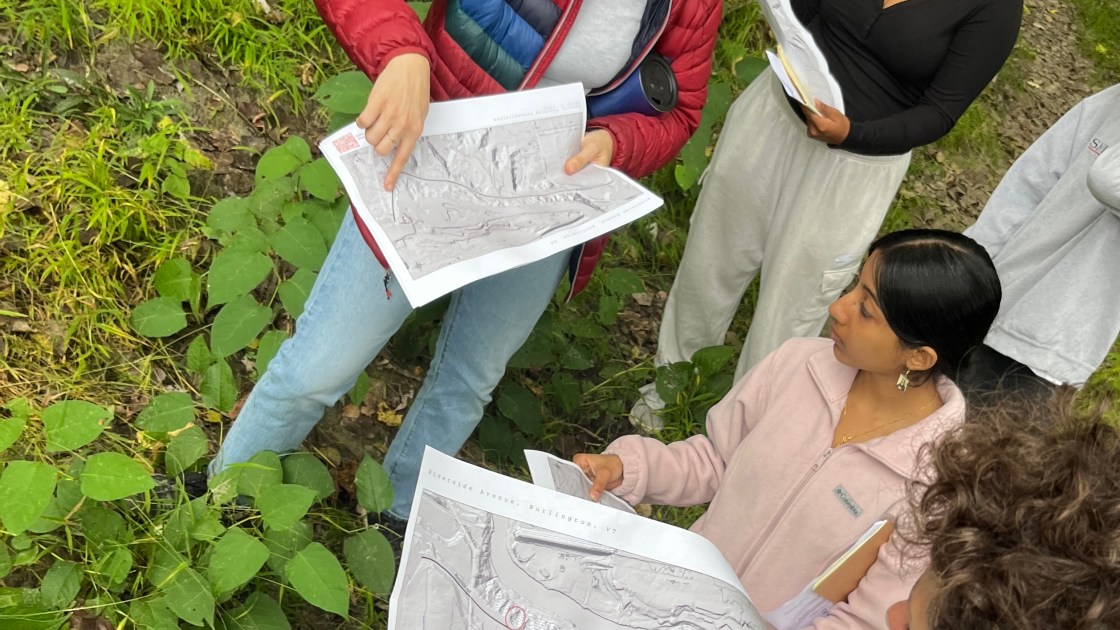
Burlington should be paying attention to other people’s experiences with floods. Throughout the past few days we have learned a lot about how floods can impact homes, communities, food sources, and more… When we walked through Salmon Hole we saw where a 2019 landslide had taken place. We also learned more about floods and how they lead to erosion which leads to landslides.
It is very important that we pay attention to these climate patterns in order to keep parts of Burlington safe. Along Riverside Avenue there are lots of buildings and homes which could be at severe risk if there was extreme weather. These big floods take everything from you like clean drinkable water, food, power, valuable items, your home, and more. If Vermont had more of a backup plan, then lots of the damage could be avoided. Something I wonder is if there is something we can do with construction to make roads and buildings stronger. I know that a lot of the buildings and homes in Vermont are very old, but as time goes on and more buildings and homes are built, I think that this is a place where we could make changes.
-Ruby
This issue is ongoing. As Bella Bennett said in a recent article, “Nearly every time I dug into the Burlington Free Press archives, I found another piece of the Riverside Avenue story,’ Bennett says. ‘The history here is rife with landslides.’ She found 20, dating back 70 years.” The issue is a question of responsibility. Philip Petersen, who works for the city, asked, “Where does city responsibility start, where does private property owners responsibility start?” Phillip told us that Riverside Ave. is home to small business and restaurants, and those business owners own the land that could collapse any day. The city of Burlington knows about this, but the property along Salmon hole is not owned by the city.
Bella, talked to us about how landslides come about, and possibly ways to prevent them. “Heavy rainfall is having a devastating impact on our state, and we need strategies to mitigate future hazards to people, infrastructure and the environment. Increasingly, these intense rainstorms cause floods, and sometimes trigger landslides.” She talked about how the last major landslide was solved the wrong way. In 1955 a big landslide occurred at Riverside, and Burlington’s solution to fix it was to stuff old car parts and trash into the land, to try and secure the slope. “‘And the way that they filled in all of that suddenly empty space was by putting hundreds of junked cars into the hole and then kind of covering that with sand,’ Bennett said. That made the land particularly prone to landslides, she said.” This “overburden” is clearly seen on Riverside, with all the trash causing the area to be unstable. The increase in storms because of climate change, along with the unsturdy slope from all the overburden is a recipe for a disastrous landslide.
- Annabelle
What is the solution to this problem? The first solution brought up in an article about this issue is reforestation of these areas. “Based on what we have learned about Riverside Avenue, our collective expertise in landslide science and our shared commitment to environmental justice, we strongly suggest that the northern side of Riverside Avenue be fully reforested. Why? Because decades of science show that tree roots stabilize slopes and prevent landslides, even in Vermont.” I agree that reforestation will help, but how long will it take? Is it something we can think of for a solution in the near future or something that may be further down the line?
The second solution brought up was about buying out and removing certain buildings. The main question that comes out for me after reading the solutions is, how are we getting the money? Is this going to be government funded? It connects back to the question I had above about how important this situation is and is the government willing to spend money on these projects? Overall, it is crucial for the Burlington community and the government to prioritize sustainable solutions that not only address the immediate risks of landslides but also promote long-term ecological stability and safety for residents along Riverside Avenue.
- Quinn


Going to the Intervale this week showed us just how our community needs its people to survive. The Intervale supports many of the families and stores around Burlington and Vermont, giving vegetables and food to people who need it. They also give space for community gardens and for people who are starting their farming careers. During the last few years the Intervale has gone through immense flooding that has destroyed crops and made it hard for all these amazing things to come out of it. The only good thing that has come out of it is seeing the community come together and help the Intervale in these hard times.
My family and I have an Intervale farm share, and we get vegetables and other things from them weekly. When the flood hit we knew they would need help so we decided to volunteer. After the heavy rain, we went down and walked out to a field where help was needed. As we got there I thought it looked fine, and was kind of confused about why we were there. My mom, brother, and I were instructed to pick potatoes on a field near the river so we got to work. For around two hours we and many other volunteers picked potatoes out of the ground… I had been confused where the water was before this point but when I was at the Northern side of the field I could see it coming. Water was seeping through the field, slowly but surely, starting in the tractor path and seeping into the gutters in between the rows.The water had so much power and we could do nothing but watch it seep into the plants.
- Miles
These days it seems like we have “100 year storms” every year. Do these records even count when they always get broken? I feel like politicians are being so casual about these crises because they don’t have to live through them. Instead of thinking about the next generation and long term consequences, they are focused on short term profit gains. I always hear about freak weather occurrences in other places, like the deep freezing in Texas a couple years ago, or tornadoes in the midwest. Climate change has come incredibly close to my door now. In my own state of Vermont, there are issues of flooding and landslides. I have noticed the changes myself over a few short years. There is less snow and it is not nearly as cold in the wintertime as it used to. The lake doesn’t freeze over as well. It makes me feel like my generation’s voices aren’t being heard. I think youth representation is more important than ever because it is the next generation that is going to inherit the world. I think we are told to limit our own carbon footprint by composting, carpooling, driving better cars, and various other things. That’s all well and good because it takes everyone to make a change, but it is not the average citizen that is fueling climate change. It’s large corporations and countries that refuse to be mindful of their actions, and the fact that they’re trying to pass on the responsibility to us rubs me the wrong way.
- Pramudita


Wendy and Stefan, of Red Vault Productions, are residents of Proctorsville, Vermont, a tiny rural town of only 334 people. The Great Flood of July 2023 ravaged their small town, forcing the community to fend for themselves, and inspiring their documentary, The Forgotten. This film highlights how towns like Proctorsville face the harsh realities of climate change and the struggles that come with it…The film reveals the deep vulnerability in Proctorsville, showing how its residents experienced collective trauma yet channeled that pain to rebuild and support each other, often with minimal federal assistance. People set aside differences to provide the support they all desperately needed, embodying the strength that comes from community resilience. Real recovery relies on people coming together, advocating for one another, and initiating change at a local level.
- Winslow
The movie created and shared by Wendy and Stefan was truly one of the most moving and inspirational things I have witnessed, in and outside of BCL. It showed a small community in the middle of Vermont having their livelihoods torn away from them in seconds by the flood, but still rallying together to address their concerns, and aimed to rejuvenate their community with little to no outside help, just the care and trust from their own people. To me, that is a perfect example of one of our BCL themes, Civic Engagement.
This small town relied on local people to salvage and even improve people’s livelihood after such an immense disaster. It honestly seems like cities like Burlington need this type of support. Yes, Burlington does have great community engagement, but with serious issues like homelessness and with such a relatively small support system of people who work with these homeless people, why not become more proactive like the residents of Proctorville, and support in any way we can? Maybe we can find guidance and inspiration from the mental health workers of Vermont who actively gave assistance to those who were affected by the summer floods last summer.
- Remy
In BCL, two people drove two hours to come to our class, to show us their movie about the flood that happened in Proctorsville, VT. The people weren’t aware that a flood would hit their area and they had to move their stuff either upstairs or away from the water. It was hard for them to get some help because the fire department was struggling to get over there and people were just worried.“I just called the fire department and they said that it’s going to take some time.” Another person said “They’re not even helping us, look at this.”
After the flood, when people started to come back home, they saw their houses were destroyed…the roads were destroyed and their property was not looking good. A lot of people were sad about their homes being messed up by the flood, some people worried about the animals and their farms. But then people started to help the town and rebuild it the way it used to be. A lot of people came out and helped the community and helped other people with their houses and stuff that were destroyed in the flooding, showing that everyone has a job to help the community. Like someone said in the movie,“Everyone should help everyone.”
- Lazizi
I feel like we should all make a change. The filmmakers who came in today gave me a real insight on how we can make the environment and the community more sustainable and welcoming. We need to find things that are causing these hazard situations to occur and try to do whatever to help prevent further harm or damage to our community and environment.
- Gaston
My whole life Burlington has always been far away from natural disasters. The most we get is a light rain here and there. The filmmakers made a point that community could only be made through crisis. Right now Burlington is as separated as ever, and we need something to fight against. Someone once said “Humans only come together to fight a common enemy,” and I have always found that to be true. So does Burlington need a disaster? No, but what Burlington needs is something to fight for.
We are in a predicament in terms of Vermont as a whole. Vermont is one of the most eco-friendly states in the nation, but we are seeing what we once called “100-year rains” almost every year. Aid for all of these places is really hard to get when there can be many towns wiped out in one storm. What the state needs to do is get people involved and get them to care. There should be buses from each school to go to these places for kids to gain community service hours and care for their people. Vermont needs to be unified so we can all face our challenges as one.
- Gus
As we learned with our conversation with Wendy and Stefan, they were able to make a beautiful community out of a horrible disaster. People in the town of Proctorsville were able to not only bond over the destruction of their homes and town but also be there for one another. After watching The Forgotten and talking with Stefan and Wendy who made the film, I was left with a major question that I was lucky enough to ask them. “Does it take a disaster to happen to bring a community together?”
Wendy said, “When backs are up against the wall you lend a hand and share a skill.” This made me really think about how in a community, whether you know each other or not, you just have to be there for one another in case someone needs help. After reading the Vermont Public piece, Central Vermont’s queer community is on the front line of flood recovery, it made me think about how people that don’t feel like they belong in certain communities can find one through tragedy, like flooding, because it brings people together. The article talked about how queer people were having a hard time finding community but after the flood people needed to rely on each other for help, which created a new community and sense of belonging. Destruction due to climate creates the need to be resilient because there is no other choice. The saying “it takes a village” really is true. When a disaster strikes, whether it’s due to climate or not, resilience is easier to come by with the help of others in the same situation.
- Belle
Climate resilience is important to the community. As shown in The Forgotten, community members formed bonds through their collective struggle with the flood. While I don’t believe disasters need to happen in order to bring people together, in some scenarios it can help. On a much bigger scale, people who are passionate about climate action and fighting climate change are brought together. For example, in Antigua and Barbuda, the isle of Redonda used to be a barren rocky island with little biodiversity. With the help of a local non-government organization, the Environmental Awareness Group (EAG), as well as the Fauna and Flora International, it was transformed into a place bursting with biodiversity. Arica Hill, the EAGs executive Director says, “This is the largest marine protected area in the Eastern Caribbean; it showcases the amazing work that conservationists and environmentalists can do right at home”. Not only that, but it showcases cow people will come together for a cause that’s important to them.
- Kuba


The thing that Connects these three experiences together is community. All three of these experiences throughout the three days showed how important strong and close communities are, and the benefits to it. When hearing about the landslides happening at the salmon hole, those houses and businesses that will be affected. We learned about how landslides have a big impact on communities and looking out for one another and helping those businesses will be very helpful. In the film we just watched, everyone in the small town had something they were good at, and spread their skills around giving everyone the help and support they needed. A quote from one of the residents was, “I would be on the first stage of the process if it wasn’t for the help of the community.” This shows how important a close community was, in a very vulnerable time for everyone. The Intervale invests in the community through the food and programs they have. They have the biggest community garden and grow food for thousands of families. The Intervale strengthens the community and grows many people closer together.
- Glenna
It feels scary to be part of the first generation growing up with problems that my parents never had to face. They didn’t grow up worrying about climate change spiraling out of control or extreme weather becoming the norm. They weren’t constantly bombarded with news about rising sea levels, wildfires, and species going extinct. It’s like we’ve been born into a world where these issues are just facts of life, and we have to figure out how to deal with them, even though they weren’t caused by us. What’s even more frightening is the sense that we’re running out of time. Every year, the warnings about climate change get more urgent, and it feels like there’s only so much we can do before it’s too late. There’s a growing fear that we might not be able to reverse the damage that’s already been done… It’s like there are so many new problems to deal with, and it’s hard to know where to even start.
- Sienna
Honestly, [facing these challenges] is kind of scary. When it comes to things like going into your first year of high school or your first job, these are things your parents have gone through as well and can ask them questions about them. These climate issues and other community issues we have learned about this week are things our parents have not experienced and can’t answer questions about. It feels uncertain, like when wizards have a crystal ball and anything could happen. I think this just means we as a community need to come and stick together to tackle issues regarding climate change and other relevant topics. We need to communicate more and talk about real-life issues instead of ignoring them.
- Jo
My parents did not have to grow up and deal with some of these problems, and it kind of creates a barrier between possible conversations I can have with [them] about these topics. Although the flooding is relatively new to all of us, I have a better understanding of it because I am able to see it firsthand and then discuss/learn about it in school. It may be a good thing that this generation is growing up with these issues because we will then be able to solve them and put things in place that will prevent them from happening. I feel like each generation had a lesson or something that they were able to change, whether that be for good or for bad. This generation will hopefully be able to solve and prevent these issues and not postpone the issues for the next generation.
- Joshua
Climate change is one of the biggest issues the world has ever faced. Just like in the documentary, The Forgotten, we need to settle our differences and fight together for the greater good of our Earth. We asked the filmmakers what would have happened if they didn’t have such a supportive community to help everyone with clean-up, and they said the recovery would have taken years instead of just a couple months. This tells me that we need community in order to fight back. If we are constantly sidetracked by meaningless things like racial and gender inequalities, then we can’t even start to fight back together. It takes everyone to make a change this big. Even though it might not be our generation who caused all of the problems, it is still our responsibility now to right those wrongs and move forward.
- Quinten
 Burlington City & Lake Semester