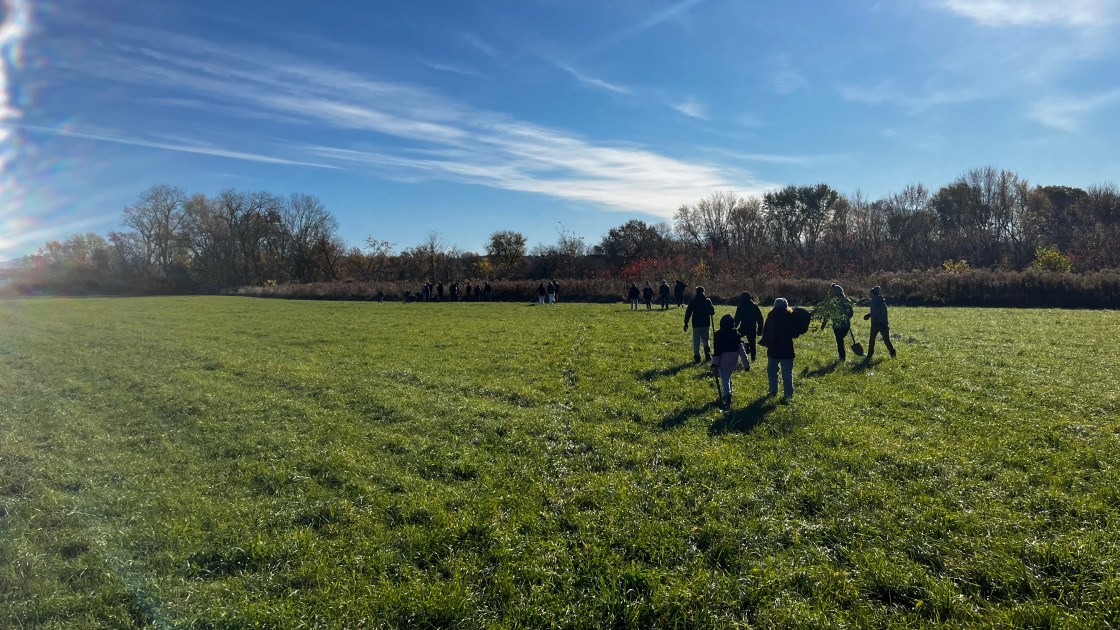
Each BCL semester is different, but no matter the year and no matter the season, we always find a way to get our hands dirty. After all, a thriving place isn’t just made up of infrastructure and city systems. It is also a place where natural communities are alive and well.
By grounding ourselves in natural systems, we are able to connect to this place we call home, and begin to see ourselves as stewards. Land-based learning also adds richness to our understanding of sustainability, civic engagement, and community. And when we apply a social justice lens, it allows us to ask a core question, “Who are our parks and open spaces for?”
In recent days, BCL13 students have had a wide range of experiences, including
- Consulting with UVM Transportation Research Center on equitable access to the Ethan Allen Homestead
- Removing invasive species from the woods along Englesby Brook
- Harvesting willows and dogwoods from the Champlain Elementary School’s “stick garden”
- Planting those stick-trees at the Homestead, and harvesting more sticks for our elementary student friends to grow for next year’s plantings
- Hosting students from UVM’s Place-Based Education Certificate Program
- Visiting Shelburne Farms, to learn about that organization’s approach to sustainable agriculture
With every experience, every partnership, and every project, students are feeling more and more connected to this place, at the ground level.


As I dive deeper into answering my question about how cities use parks for community engagement, the author sheds some light on the importance of parks holding community value, and how they can represent inclusivity. They also emphasize that parks are much more than physical spaces, they are also civic and social hubs. Not everyone feels the same sense of place at these parks. So, how do we create a sense of place?
To me, this is much more than the designs and strategies within the parks. We need to add a more intentional community integration of welcoming. For example, regular events celebrating diverse cultures, creating more welcoming spaces in multiple languages, or even offering assistance if needed by different communities. Everyone feels they should belong.
- Jacques


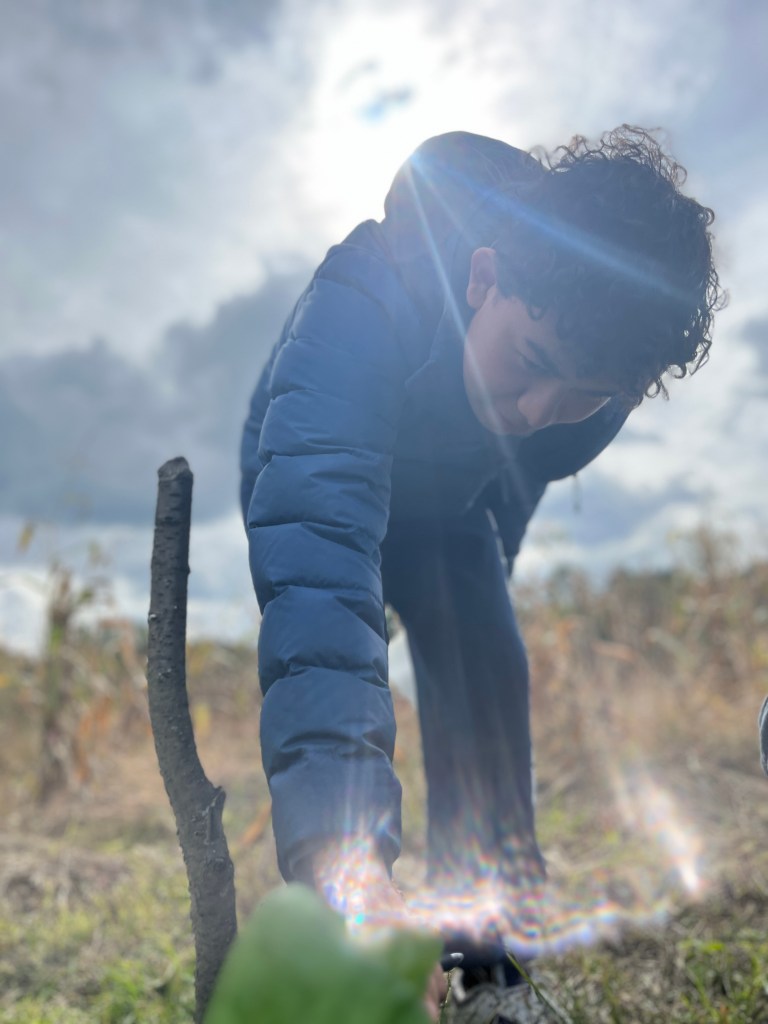
I think digging up and planting trees may have been one of my favorite activities we’ve done at BCL. Having been previously educated on the impact of trees on riverbanks regarding flooding and erosion, planting trees became all the more meaningful. I think being with the 5th graders also helped bring our own community together. We had a collective goal of digging up the invasive species and the trees from the stick garden.
At the same time, we were all being mentors to the fifth graders. I think this activity connected most to our themes of community and sustainability. Community was built through the relationships that were formed and strengthened. Sustainability was shown through the physical digging up and planting of trees. It was also shown through the education and engagement of the youth. Educating the youth is sustaining the future by giving them the resources they need to help the planet thrive.
- Kuba
When reflecting on our work at Champlain Elementary School, digging up the invasive trees and transplanting them to the homestead, I felt like really was making a difference and it was a really fulfilling experience. I felt connected to nature and I also became close to the people I was doing it with, the 5th graders and my peers. This experience made me think about how we were contributing to sustainability in our community. Before doing it I just thought we were planting trees for learning but in reality, we were also creating a healthier environment for us and the animals around as well.
- Glenna


One thing that we did at BCL was take out the trees that were planted by the elementary kids. We did this because we were going to move the trees to the Ethan Allen Homestead. This was challenging because we had to dig six feet away from the plants so that the roots could spread.
The hard work we did was very helpful to the community. Sadly the fifth graders or the third graders weren’t with us at the time and I was kinda sad about it because we became good friends, but we got a chance to play football with them during recess. I like the experience that we had that day, now the trees that we picked up are heading to Ethan Allen for us to plant and help the community.
- Lazizi
We found out that we would be spending time with fifth graders, acting as role models for them. This would be a great chance for us to connect and share our knowledge. Once the fifth graders joined us, we formed a circle for a brief discussion. The students excitedly shared their experiences about the trees and the animals they had seen at the school before.
After our talk, each of us paired up with a fifth grader. I liked how the kids approached us instead of waiting for us to come to them. One boy named Mohamed came right up to me and asked if he could be my partner. We quickly connected and seemed to become friends. We then gathered our tools, prepared ourselves for the work ahead, and began our tasks. The first group went into the woods to cut some invasive species. Mohamed offered to carry the tools and he even said that they weren’t heavy. I know we were supposed to be role models for the kids but I felt as if my partner was a role model for me. He ended up grabbing the tool and seems like he already knew how to use it so I didn’t even have to teach him.
- Josh
One of the most memorable parts of my time at Champlain Elementary was working with my partner, Soren. We talked a lot as we worked together, and I felt that we related on so many levels, despite the difference in our ages. We spent the day uprooting trees, and what could have been just a chore suddenly became a lot more enjoyable because we did it together. I couldn’t help but think back to when I was Soren’s age, and older kids would come into my classroom. Back then, I thought they were the coolest people around… When we build relationships that inspire us to be our best selves, we lay the foundation for a community that doesn’t just survive but truly thrives.
- Max


With climate change on the rise, it is extremely important to have healthy trees because they help to remove carbon dioxide from the air which is the major fossil fuel contributing to climate change and what is heating up the Earth. According to the US Forest Service “Trees draw carbon dioxide from the atmosphere through a process called photosynthesis. Plants use photosynthesis to produce various carbon-based sugars necessary for tree functioning and to make wood for growth. Every part of a tree stores carbon, from the trunks, branches, leaves, and roots.” This means trees are a crucial part of Earth systems.
- Ruby


What does it take for a community to thrive? This question has been the overarching question for all of our time in BCL. For me, a community thrives when it is built and livable and enjoyable for all ages, an 8-80 City. On Friday, October 25th, we went down to Champlain Elementary School to dig up and cut down trees. It was awesome to connect with these kids and see what they are learning about in school. I thought it was great to get outside and engage with the kids and see how they learn and what they learn.
On Monday, we met with college students from UVM. The college students were in a program called “Place-Based Learning”. These college students are much older than the 5th graders we met with, but I can see a lot of similarities in learning… I could see the level of attention [from each group] and want to learn more from each group and that is what I think is great about this community. I love that I am able to see the similarities in people who are more than 15 years apart.
- Quinn
When the UVM students visited, I had the chance to have one-on-one conversations with a few of them, I had a memorable discussion with a girl named Nina. She asked me questions that pushed me to think deeply, similar like my own journal reflections. In my journal I wrote, “She asked questions I hadn’t even considered but should have like ‘Why did you choose to do BCL?’ and ‘Is this something you want to pursue in the future?’” Each question made me pause and really think. I honestly didn’t know the answer to any of her questions. Prior to this course I lacked an interest in environmental studies and working in education. Its just something I thought I wasn’t interested in. The course the UVM students were taking I would’ve not considered but now I would explore it.
- Jo


I really liked talking to each of the different people that work around the farm and seeing how passionate they each were about their specific job. I really liked talking to Mo about the biofilm, it’s very cool that they have that as an option. I also really interested in hanging out with the animals, and the cows especially. I’m going to email the head of the farm and try to get and internship.
- Belle
I have only been [to Shelburne Farms] once or twice, and honestly it was pretty brief, so I wasn’t aware of how many organizations are here. One example is the dairy farm. I really liked learning about the dairy farm, and then going straight to learning how cheese is made here. I am left thinking about the systems in place to create all of the things produced and housed here.
- Sophie


During our time at Shelburne Farms, I got a closer look at how a farm actually runs and learned about all the systems that go into it. I’ve always known that farming practices can sometimes be rough on animals, and a lot of places are known for unethical treatment. But at Shelburne Farms, it was clear they put in real effort to keep their animals healthy, especially the cows. They didn’t just meet the minimum standards; they went beyond, which honestly surprised me. Seeing cows that were genuinely well cared for made a big difference in how I viewed their approach to farming. Reading the Cattle Care and Handling Guidelines, I realized that many farms don’t even meet these basic standards. Yet, Shelburne Farms actually does, showing that it’s possible to farm ethically and put animal welfare first.
Overall, visiting Shelburne Farms made me think a lot more about food and where it comes from. It’s clear to me now that transparency and accountability in farming aren’t just nice-to-haves they’re essential if we want a food system that respects both people and animals. Shelburne Farms shows that this approach is possible, and that’s a huge step in the right direction.
- Max
Shelburne Farms was the best place to visit! It was so much fun learning about the animals and their work there. As a kid, I loved chasing the chickens and naming them. I even named one Lady Gaga, and she became famous on the farm. I miss those times. Even now, going to Shelburne Farms makes me feel like a kid again, bringing back so much happiness and joy, especially seeing children enjoying it too.
Shelburne Farm also demonstrates a lot of sustainability for the community. It helps kids and others to learn about the place and how to take care of it. I really love what Shelburne Farm is doing.
- Lazizi


I think it was super fun to be outdoors and in nature at Shelburne Farms. I really liked being with all the animals, especially the baby cows who were super cute. The experience of all of the community partners here helping out and being so willing to help us have a good time was awesome, so I am super thankful to them. It was also super cool to spend time with an important partner with BCL!
- Miles
I think I am really going to appreciate just how much effort goes into the cows and calves — 7 days a week and 365 days a year they are walked, milked, and cared for nonstop. It is truly amazing to see, as I have heard of so many places mistreating their animals. I will be taking away just how much thought and care goes into each individual aspect of this farm.
- Remy
When we were at the dairy barn, I was so surprised at the lack of smell of the cow manure. I think using biochar could be really useful on other farms to help the emission of methane and carbon.
I also loved petting all the different animals. The goats were my favorite, because one was super chill and chewing on Sophie’s dress. One takeaway is that I think I’d rather pursue my passions and what I want to do for my career, rather than something boring.
- Pramudita

So far, the Burlington City and Lake semester has been unlike any other class I’ve taken. Stepping outside the traditional classroom and spending half my days focused on real issues in Burlington has been a refreshing change. Every day, we dive into topics that impact our city, whether working alongside scientists on Lake Champlain or speaking with local journalists. In just a few months, I’ve learned and achieved more in BCL than in years of regular classes, and I’m beginning to understand how powerful Place-Based Education truly is.
After meeting UVM students who were studying PBE, I thought about how one of the unexpected benefits of PBE is how it makes learning more engaging and fosters a stronger sense of responsibility toward the community and environment. It shifts education from something focused on individual achievement to a way of making a real, positive impact.
One memorable example was a conservation project where we partnered with local environmental groups to transplant willows grown by fifth graders at Champlain Elementary. We replanted these willows in the floodplains at Ethan Allen Homestead, and it reminded me that learning isn’t just about passing tests; it can truly make a difference. I remembered being in fifth grade myself, looking up to older students who visited our class for similar projects. Now, I was on the other side, contributing to something with a visible, positive effect on the environment.
In BCL, I’ve learned more about Burlington than I ever expected, deepening my understanding of familiar issues and introducing me to new ones. Place-Based Learning has shown me how meaningful education becomes when it’s rooted in real life. I feel fortunate to be part of a program that makes learning so personal and impactful.
- Winslow
 Burlington City & Lake Semester