Most BCL blogs shine a light on the learning experience by centering students’ voices. While this post includes student writing, it is also part of an intermittent series that pulls back the curtain on BCL theory and practice.
[Other posts in this series explore Purpose & Audience and Synthesis.]
In 2017, when the idea of the Burlington City & Lake Semester was first evolving, the program’s founders crafted a mission statement: To empower young people as citizens, students, and community members through authentic, collaborative real-world learning experiences in and around the city of Burlington. For years, this has been our north star. The heart of any mission statement, of course, is its predicate. Verbs embody action; they clarify what is happening. But in our case, we chose a doozy of a verb. What does it mean to empower young people?
Whether it is through student-led meetings, inquiry projects, or collaboration with community partners, the goal is to create the conditions for young adults to have their voices heard, and to be taken seriously. This requires a variety of ongoing investments: context-building, so that students feel informed and ready; trust-building, so that students feel ready to take risks; and community-building, so that students can engage in authentic relationships with adult professionals.
Many teachers strive to make learning relevant, but in a traditional classroom setting, the system erects an invisible ceiling. It can be hard to discern, but it’s there. Years ago, I remember walking down a high school hallway with a former colleague, Nadya, listening to the sounds emanating from classrooms. We were curious if we would hear the voices of teachers, or the voices of learners. Without a doubt, the most vibrant classes were ones in which students were evaluating, synthesizing, or debating. Energy poured out of these rooms. But although these are high-level skills, Nadya didn’t miss a beat, noting that even though students were active, the teacher remained the architect, as well as the sole audience. Students may have crafted a proposal, but it was still a simulation. They may have grappled with a genuine case-study, but the only people who heard their analysis were their classmates and their teacher. Nadya summed it up by channeling the thinking of Dennis Littky: “There’s a difference between real-real and ‘fake-real.’”
How can teachers get closer to “real-real?” One high-leverage approach is to create space for students to help solve bona fide, real-world problems. These problems are everywhere. They exist in every region, every city, every town, and every neighborhood. The world is full to the brim with issues that would benefit from a new set of eyes, and an infusion of energy. Anything that is contested is fair game. Wherever people disagree about the solution–or even about the problem itself–is the perfect place to lean in. Even if the path is clear, and an issue seems to lack controversy, it’s still nearly always missing youth perspectives. Offering this insight to decision-makers is always a win-win: students get to break the invisible ceiling and experience something truly “real-real,” and the future is informed by their unique wisdom.


While biking to Ethan Allen Homestead, I was cold, and I thought about all the families that rely on that place for food, and the journey they have to make every day. They have to walk miles just to get to your farm that you’re taking care of, then if they want to bring any food home for their family they have to carry it all the way back. I think that having Ethan Allen stay as secluded as it is now isn’t a good idea. We don’t want to ruin the natural environment, but we need to make it more accessible to everyone.
Our experience at Ethan Allen Homestead connects really well with Christina Djossa’s article about making national parks accessible. Djossa explains that parks should be open to everyone, no matter their income, transportation options, or physical ability. One of her ideas is adding shuttles to help people who don’t have cars get to these spaces without hurting the environment. [An Ethan Allen Homestead shuttle] would make it easier for people to get there, especially farmers and families who rely on the land, without taking away the peaceful, natural feel. Educating visitors about how to treat the land respectfully could help keep the ecosystem safe. As Djossa says, parks should “belong to all Americans,” and making sure everyone has a way to get there would bring the community closer to that goal.
- Quinten
During our visit to the Ethan Allen Homestead and our exploration of the New Farms for New Americans, I began to question and wonder about the marginalization of the farmland that NFNA is situated on. Getting to the farm itself is no easy task, especially because the only way to drive there is by first going to the homestead. We noticed that the farm is somewhat removed from the homestead area as it is tucked away on the banks of the Winooski River. While the entirety of the Intervale is a floodplain, the farm being directly on the river makes me wonder if the farm is more affected by flooding than a farm slightly further inland. From our partners, I learned that funding and land are not something that can just be handed out and that they are lucky to even have the land and farm at all, but I also think that it may be worth it to explore different plots of land if the current farm is struggling with flooding.
- Ale


One thing in the past few weeks that stood out to me was the collaboration we participated in to help design Pomeroy Park. The city of Burlington plans to renovate Pomeroy park’s playground in the next year and I really hope to see some of the changes my class suggested. We got to create a blueprint of what we think should be changed at the park and I really enjoyed having that creative ability and work in the city.
I think what stood out to me was the feeling of being heard. I felt as if I was contributing to the community, which is what I ultimately signed up for BCL. I want to continue to voice my opinions in BCL when we are collaborating with community partners because I think I would consider going into a profession that helps improve city systems.
- Annabelle
One thing we made sure to share with the park developers was the idea of accessibility for all ages, from 1 to 80. When we stepped into the playground at Pomeroy Park, we realized that there was a massive step down to enter the playground, so if a 3-year-old or an elder were to join, there could be an issue stepping into the area. This is a big concern and could be hazardous, and we must realize how we can make it accessible to everyone.
- Jacques
During my Freshman and Sophomore year of high school, I took two engineering classes. In both classes, we designed things and had them turn into realities–bridges, model rockets, and more. The park planning we did made me think of my engineering class, and how the people who are make decisions about the parks for our city are also designers. It’s hard to explain, but doing creative things like that gets my creative juices flowing, and has an excitement to it that nothing else like it has. The idea of creating something that others can use is special, and I had this feeling when drawing a new map of Pomeroy Park.
- Miles
It’s not hard to find a real-world problem that needs attention. The trick is how to approach this problem in a way that is empowering to learners, and mutually beneficial to all stakeholders and collaborators. Often, well-meaning adults end up unintentionally tokenizing young people. Countless times, students have been invited to a board meeting or a public forum, even though the culture in the room remains firmly adult-professional. The younger participants listen and do their best to engage, and then a moment arrives when a beneficent grownup turns and says “What do you think about all of this?” The room goes silent. Heads swivel. The student awkwardly shares a response, and the adults in the room are immediately sated, confident that they’ve checked the box. The intentions may have been good, but without leveling the playing field or meeting young people where they are at, a moment like this one ends up codifying the adults’ role as gatekeepers.
For years, research, essays, and popular publications have promoted the idea of “amplifying youth voice,” but merely turning up the dial doesn’t ensure that anyone is listening. To do that, teachers and learners need to build deliberate relationships with community members. Interestingly, it often takes just as much time to onboard these partners as it does to build context for students. This may feel tedious, but it’s worth the effort. When both groups arrive ready to get to work, we have set the table for something far more powerful than merely merely “amplifying youth voice.” Young people are heard precisely because we have helped create the conditions for adults to truly listen, and professionals gain true partners with wisdom that they would never have otherwise harvested.


I really loved having the ability to reflect and share about my time at BCL with the visiting teachers. The teachers seemed to be enthralled and enthusiastic about initiating something like BCL in their school, and I hope what I shared today will impact those in other school districts.
- Gus
I really liked that [the Hartford teachers] were really showing an interest in what we do. Their questions and curiosity made it feel like we were making a powerful impact. I was really curious about how the math teachers were going to incorporate place based learning into their fields.
- Jo
Youth-adult partnership can take many forms, but one of the most impactful, reciprocally rewarding approaches is for students to consult on real-world dilemmas. The inspiration for BCL’s student consultancies began in 2012, in a course called School Innovation Seminar. A social studies elective, SIS was a course in which high school students studied the sociology of education and then actively engaged in school redesign. Over the course of six years, students consulted on issues as diverse as Advisory design, heterogeneous grouping, tardiness policy, and personal learning plans. Students helped redesign coaches’ feedback forms; they addressed the lack of diversity in student government; they analyzed Youth Risk Behavior Survey data and advised our student support team. For the years that the SIS course ran, the school had an R&D arm – and the engine was students’ own insight.
The best dilemmas have a variety of potential solutions, and often every one of them is problematic. The easy answers aren’t obvious, and the obvious answers aren’t easy. This is how the world works, of course – which makes dilemmas a sandbox for numerous transferable skills: open-mindedness and inquiry, complex systems thinking, empathy and perspective-taking, collaboration, etc. In a simulation, the teacher knows the answer, and students clamber to get as close as they can; in a real-world quandary, everyone at the table–students and adults alike–are facing the unknown together.
Open-ended inquiry can be overwhelming. One way to organize that process is to use a consultancy protocol, in which community partners are the dilemma-bringers and students are the consultants. In SIS, we quickly learned that no matter how large or how small the issue, successful youth-adult partnership calls for preparation, on both sides. Students need context for the dilemma – the history of the issue, the values spectrum, and the potential impact of different solutions. Adult partners need active support as they frame their dilemma and hone their question. They also benefit from proactive reflection on ways to level the power differential in the room.


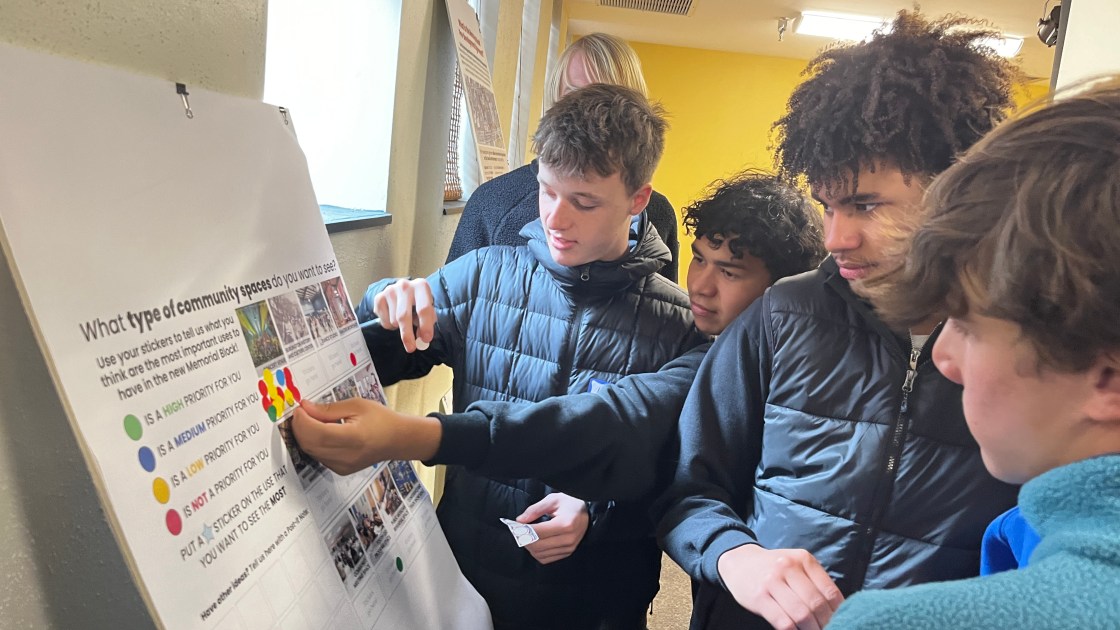
In BCL, we met some people who were thinking about the Memorial Auditorium building. They needed help deciding what the building, which has been around since 1927 should be. When we checked it out, we saw rods for holding the bricks up that were rusted. The bricks were really old and apparently they were falling… After our tour, everyone had to decide what the building should be. Most of the class said it should be a community place where college students or kids from the middle school could hang out. Some said it should have a pool, because Essex and Winooski have theirs and Burlington doesn’t have one. The day was great. It was fun to think about what a place should be and help people with good ideas think about the future.
- Lazizi
It was really cool to share my input on a space that I have grown up using. There are so many different opportunities that could come from that building, especially places for youth. It made me realize how often decisions are made with only input from the city’s adults, but changing that could have such a beneficial impact.
- Glenna
The Memorial block consulting experience was very similar to the consulting we did on the future of Pomeroy Park. We were able to get a view of the situation and see what was going on. Then, we were able to brainstorm ideas and plans to make the designs better. It was good that they got insight from younger people.
- Quinn
It was cool to put myself in the shoes of someone that has to do big project planning. It gave me a sense of appreciation for the people who are in charge of planning these things. This project leaves me thinking about the city, and what we can do to save other spots just like it. It could also open up a great opportunity for solving part of the housing crisis.
- Joshua
Ideally, the best dilemmas meet three key criteria:
- They are authentic, real-world problems – not invented by the teacher as a way to apply or practice skills. (In other words, they are “real-real,” not “fake-real.”)
- They are within the dilemma-bringers’ own agency. (That is, the consultee can actually do something themselves; the dilemma doesn’t require someone else to change)
- The dilemma is something to which young people bring unique insight and wisdom. (It’s not something you could get the same perspective about from a colleague down the hall.)
If those three criteria are met, then the stage is set for the consultancy to be valid, impactful, and empowering.

Building on the success of SIS’s model, the Burlington City & Lake Semester program has adapted student consultancies to be public facing. Instead of engaging in school transformation, students in BCL focus their time, energy, and wisdom on the future of their city. Since 2018, students have engaged in a wide range of consultancies, including:
- Helping establish and augment the City’s first Equity Report
- Envisioning the future of Moran Frame, an architectural urban design project
- Informing the design of a new high school
- Convening a variety of community partners to discuss the future of the Urban Reserve
- Consulting on transportation plans, and helping ensure that marginalized voices are included in the planning process
Over the past few weeks, BCL students have partnered with city departments to reimagine a neighborhood park; they have helped redesign of a once iconic and now decommissioned civic building; they have consulted with educators from across the state, and across the country, about increasing access to place-based learning; they have added their perspectives to a research study devoted to increasing equitable access to parks; and they have consulted with our district’s equity team on the utility of district-wide disparity data.
Youth-adult partnerships like these don’t allow anyone to phone it in. Invariably, they stretch youth and partners alike. Students need to step out of their comfort zones, but so do community partners. After all, it’s not every day that adults sit down with teenagers and dig into problems that are vexing even to seasoned professionals. These collaborations ask everyone involved to dig deep, and to draw on skills that rarely show up on a classroom rubric: humility, courage, ideation, deep listening, and the ability to search for commonality. The good news is that the world desperately needs more of every one of these things, and by working together, we can nurture them all.

Youth-Adult Partnership and Consultancy Protocol
Best Practices
Build context. Help students feel informed enough so that they can ask better questions, and practice deeper thinking.
Invest in relationships. The best consultancies grow from active collaboration with community partners.
Craft a fruitful dilemma. Use the three criteria listed above, to help ensure validity, impact, and empowerment.
Flatten the hierarchy. Use protocols to level the default youth-adult power structure.
Don’t rush it. Build in enough time to extend the protocol if/as needed. (Sometimes clarifying questions require more time; sometimes discussion requires more time.) Ideally, the protocol requires at least 80-90 minutes.
Practice. It’s worth taking the time to run through the protocol beforehand, with a benign and low-stakes dilemma.
Write-to-Think. Whenever it feels valuable, consider giving students even a few moments to write down their thoughts before they are asked to share. This equalizes airtime, and allows slower processors to fully participate.
Circle up. When the protocol is over, carve out at least 5-10 minutes for students and community partners to circle up. This should be a time to step away from the content of the consultancy and reflect together on the value and impact of doing this work together.
Reflect, reflect, reflect. When? Before, during, and after. Anything and everything is worth reflecting on, but it’s never a bad time to reflect on the experience itself, using a key experiential-learning prompt: “What is/was it like to do this?”
Invest in gratitude. Students can write thank you notes, or convene a brief follow-up session. It is both meaningful and empowering to hear partners reflect back what they are taking away, and how the students’ insights will have real impact.
Tell the story. People need to know about the power of authentic community engagement. Consider a variety of audiences – and invite students to be the storytellers.
 Burlington City & Lake Semester