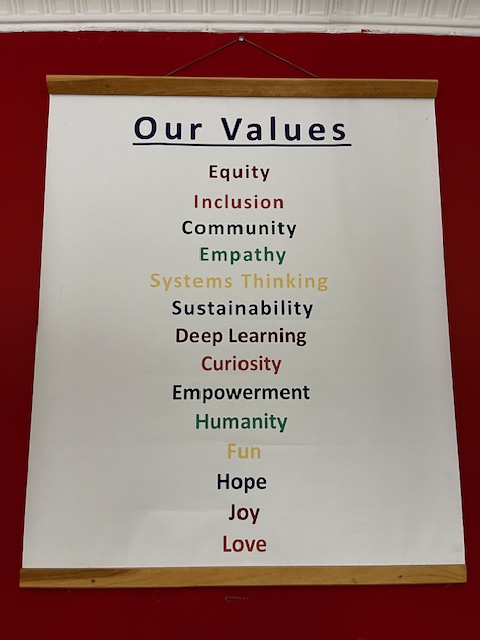
A poster with a list of Burlington City & Lake Semester’s core values hangs prominently on one of our bright red classroom walls: equity, inclusion, community, empathy, systems thinking, sustainability, deep learning, curiosity, empowerment, humanity, fun, hope, joy, and love. Each day, we practice these values through our authentic engagement with community partners and the ways we treat each other.
Living our values looks like listening closely to the people working hard to address Burlington’s housing crisis, asking thoughtful questions, and, at the end of our time together, expressing gratitude for their passion and commitment. It sounds like our voices speaking up during Circle, when we share what’s on our minds, and our infectious laughter during Fun Block when we play games like The Thing from the Future and Salad Bowl. It feels like having our hands in the dirt, planting willow and dogwood saplings along the Winooski River to help mitigate the impacts of flooding brought on by climate change.
In early November, we spent a morning identifying the values we hold as individuals, and, while there was some overlap with our program’s values, new ones emerged: reliability, open-mindedness, and growth, among others. This exploration led us to essential questions that have guided our experiences during the past few weeks: What values does the American educational system impart? And, how similar or different are they to BCL’s values, and our own?

I think the values of sustainability, love, fun, sense of place and many more are very important in BCL and actually show up. In BCL I think I have fun and “love” because when we go places we are doing cool things and getting out of the classroom instead of just sitting in school all day … [E]ven when we are in class at the ONE Center we are almost always not doing busy work but doing things that are engaging and seem interesting; we are also learning important things. I have learned way more about our city and real life experiences, jobs, and people in BCL than I ever would sitting in a classroom, which has taught me about sustainability and all of the other values.
- Miles
The values of community and equity are alive in a traditional learning environment. Along with those values, BCL also shows a big value of curiosity. This has been found in all of the assignments and work we have done. In Inquiry Projects and Expos, we are showing what we are interested in and bringing that learning even deeper. When talking to community partners and students/teachers, both [the PBE students and the Hartford teachers] brought so much curiosity for what BCL is about, having many probing questions.
- Glenna
The focus should be on teaching kids fundamental skills that are useful for their age and will help them as they get older. Building a strong foundation in areas like problem-solving, communication, and understanding emotions is important. At the same time, letting kids explore what interests them makes learning more enjoyable and meaningful. By combining important skills with their interests, we can create an environment that helps them grow both now and in the future.
- Max
Vulnerability and transparency from educators themselves has become much more important to me. When I actually believe that my teacher cares about my learning and isn’t just going through the motions of the lesson, I feel much more inclined to engage in the lesson. It is when Dov, Emily, and Christie really open up, whether that is through their own stories or thoughtful questions, that I understand and am more engaged in my learning.
- Ale
Over the last month, we have learned about the history of public education, and how schools often seem to prioritize compliance, efficiency, and conformity. We have spoken to community partners representing organizations working to make schools more just and equitable. We have offered insight to educators from Hartford High School in Vermont’s Upper Valley seeking to design a BCL-inspired program. We also discussed our experiences from this semester with students from the University of Vermont’s Place-Based Education Certificate Program, and consulted with the Burlington School District’s Office of Equity, offering suggestions on how to increase the access and utility of data in the annual Equity Report. The topics of these conversations have ranged from the impact of the Industrial Revolution on public schools, to the current push to ban books from libraries and curricula, to what place-based education looks like on the ground level.


Our time with the Hartford School teachers was really valuable to me. I thought it was great that teachers from a different school in Vermont found an interest in a program that was more than an hour away from us and they wanted to come up and learn more. They came in with thoughtful questions and it was great to consult with them.
- Quinn
The uniform feeling of school is an instant turn-off for a lot of students/learners. I hear all the time from students that what we learn is boring or uninteresting. We need to personalize education and open up as many possibilities as we can for students who want alternative learning. We talked about equity in school and where we do and don’t see it. I see equity in what classes are offered but not equity in the way those classes are taught. We are told that there is a certain way to learn something but if we show that learning can happen in different settings then students will feel more appreciative of their learning and the processes of learning as a whole.
- Quinten
The school structure as we know it was created during the Industrial Revolution to create good factory workers. I think more free thinking should be encouraged instead of being forced to learn knowledge and then tested on it. Real world experiences should be emphasized in order to make school a learning environment for everyone because there are kids that really struggle with the traditional school structure. School should be for everyone instead of just those who do well at memorizing information.
- Pramudita


I found the visit with Hartford High School and our time with the UVM [Place-Based Education] students most impactful… Both were similar in the sense that these people were seeking out education and information about place-based learning and wanting to work on implementing it more. This gave me a window into what could be possible in my future. I am applying to UVM, and if I get in, I would want to work toward the Place-Based Education certificate. In terms of the Hartford High School teachers and their visit, their takeaways were most interesting. They seemed impressed with us as people and our ability to articulate what we liked about the program.
- Sophie
Schools are meant to have a lot of opportunities to have fun and have a chance to learn a lot while doing it. I think if schools were just like BCL, I think it would be ten times better. When kids are able to leave school, take a break and learn a lot while doing it, they won’t be bored. I [think] if schools make these changes in their buildings, more people would like to come to school.
- Lazizi
[In the traditional] education system … there is not much wiggle room for creativity and youth voice. I think traditional school values include ones like discipline and structure of learning. I think there is a value of connection at BHS; I think all the teachers do a pretty good job at trying to connect with students and lighten up their classrooms. BCL is very different, although there is an agenda for learning, it doesn’t feel like there is. I think this is a good thing because it opens up for creativity, along with fun and community … Not every experience is going to be the same, and the experiences are not rehearsed. This sparks new ideas and teaching moments at BCL.
- Annabelle
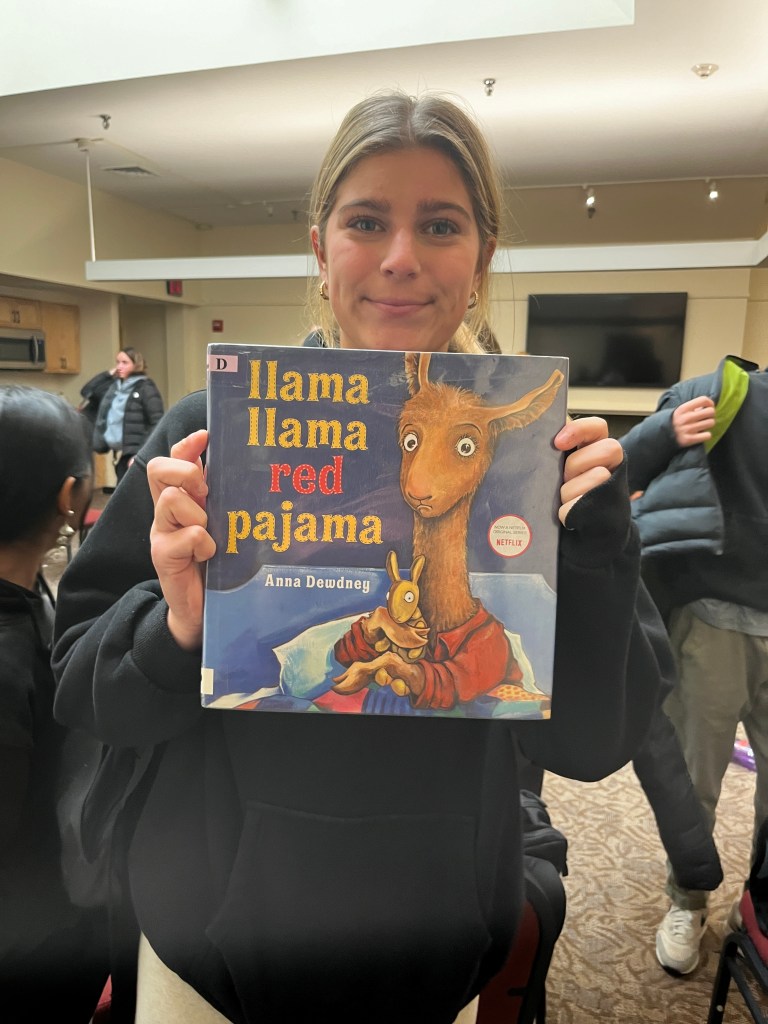
BCL13 students then shifted their focus to our culminating “Books that Matter” project. They visited Fletcher Free Library and worked alongside Youth Library Manager Megan Butterfield to select books to read to kindergartners and first graders at Integrated Arts Academy. Megan curated a collection of children’s books that reflect our list of values, and students chose one book to read as a group, and one individual book to share.


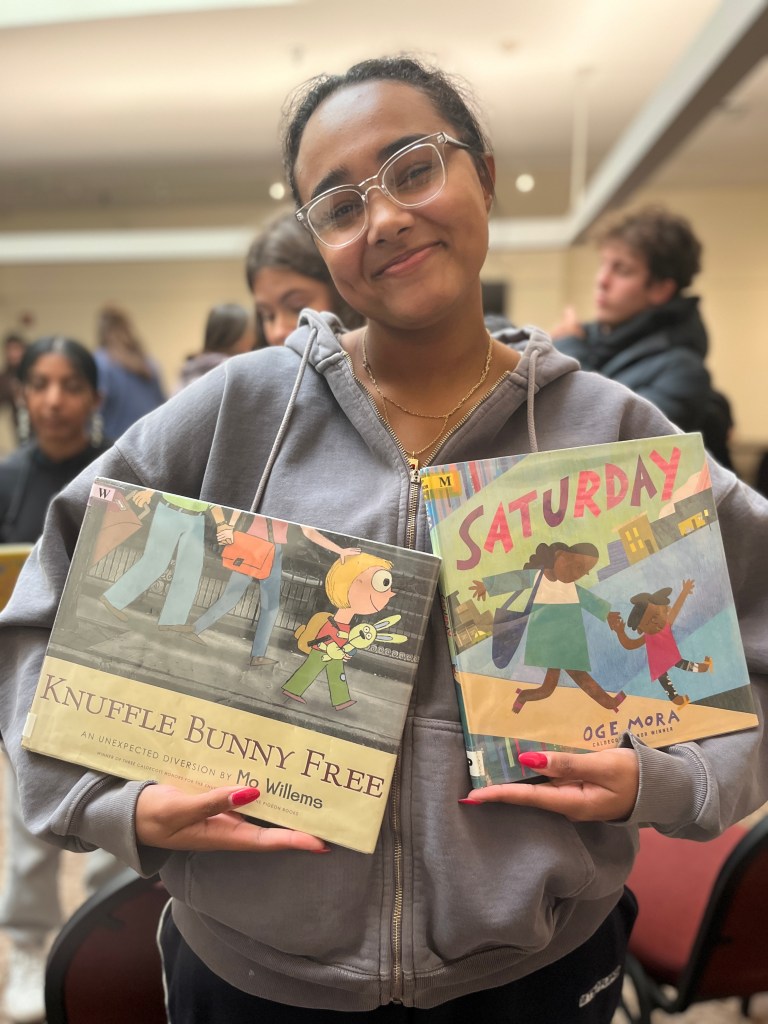
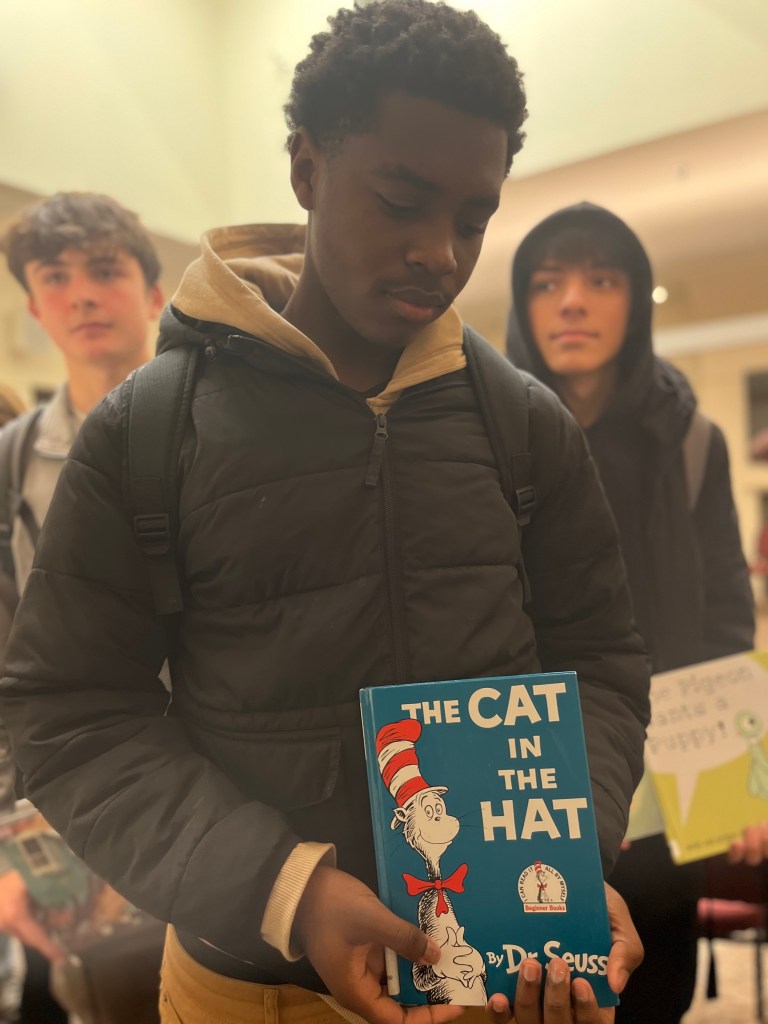
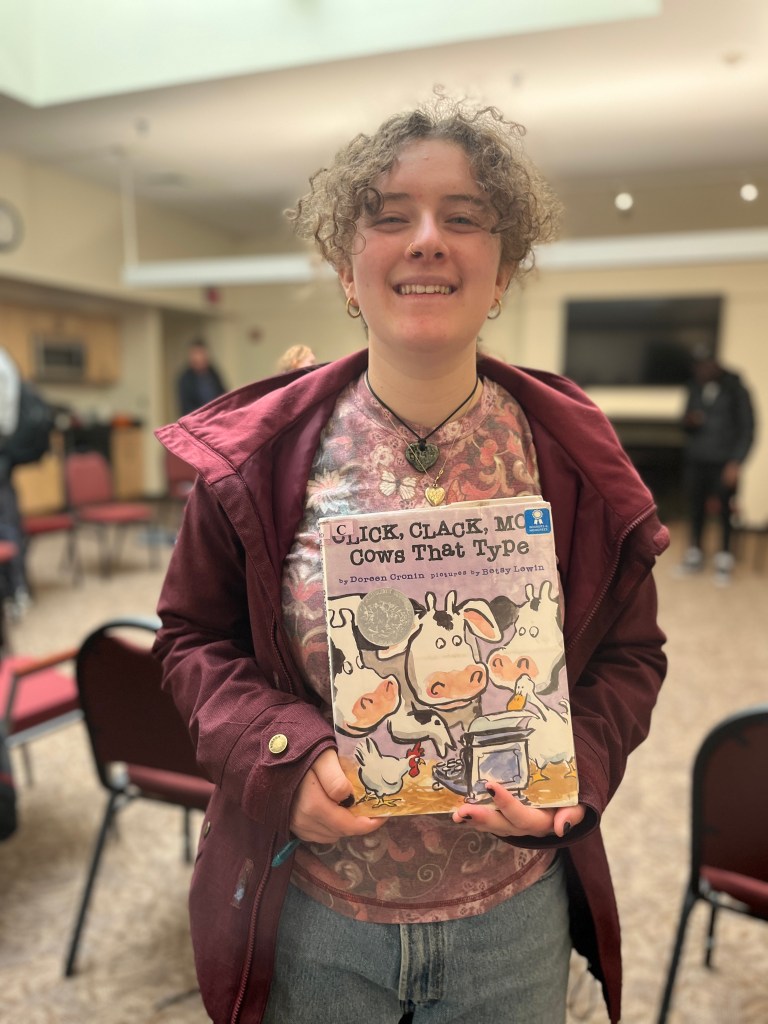
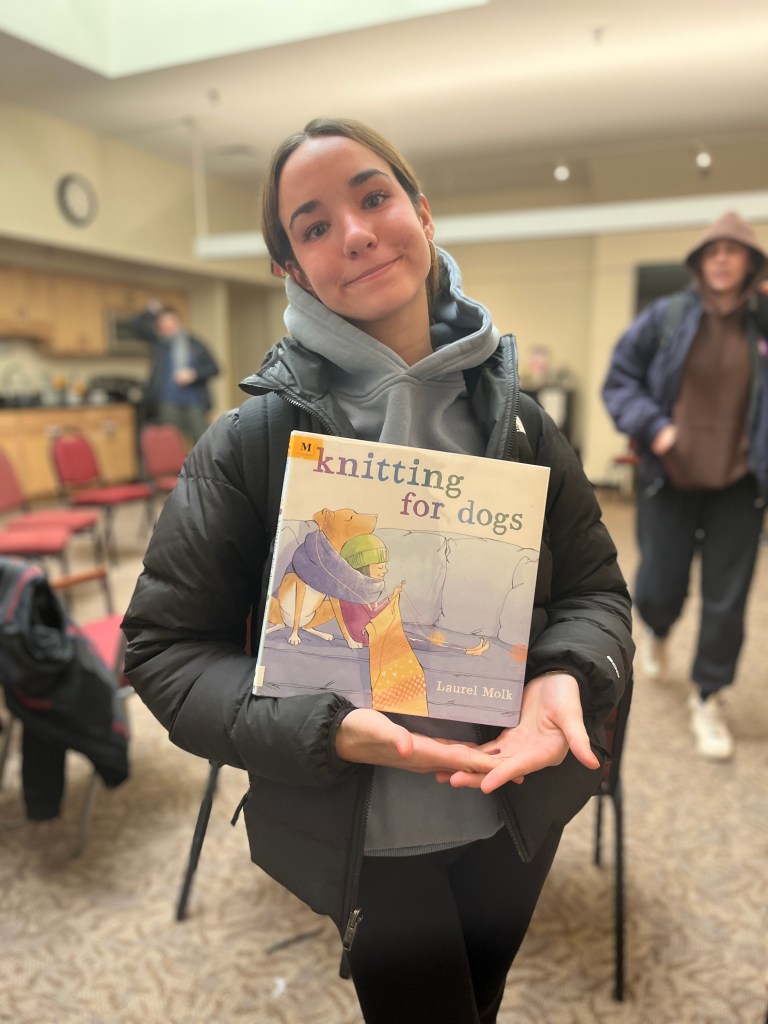
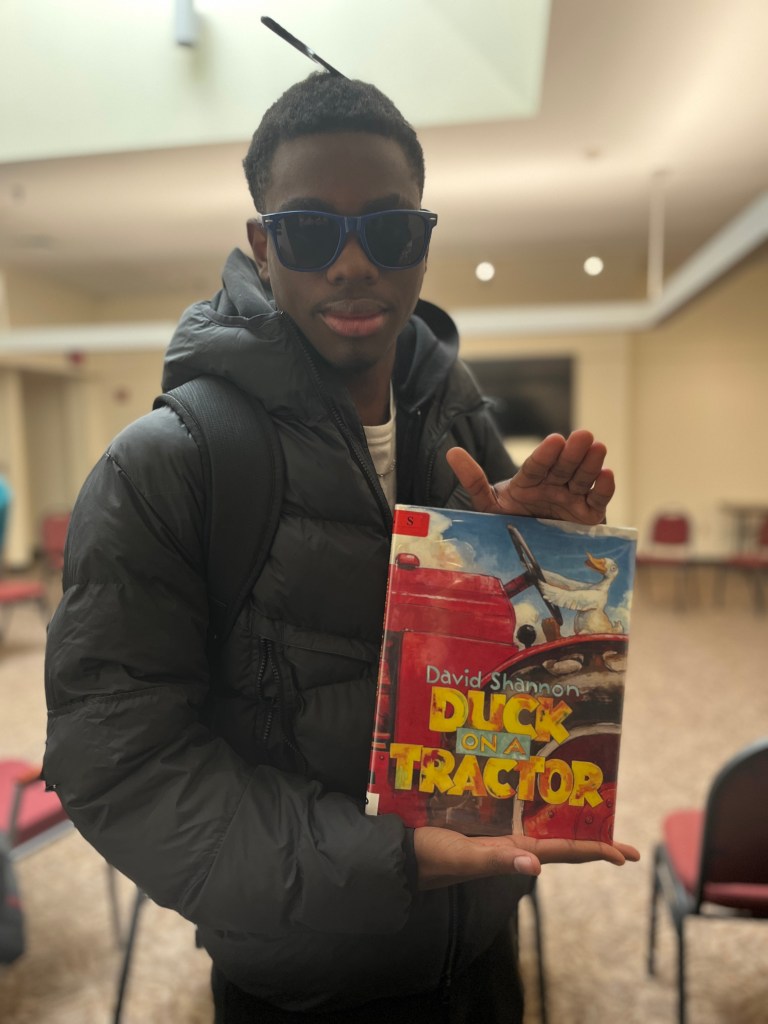
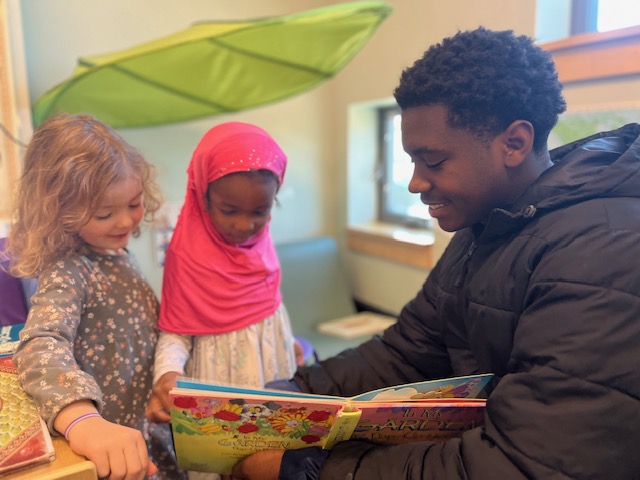
When BCL students entered the elementary school classrooms, the kids buzzed with anticipation. Their eyes were wide and they sat still as the “big kids” began to read; they were attentive, quiet, and engaged. When the high schoolers finished reading, and invited the kindergartners and first graders to sit with each of them in groups of two or three, the energy in the room shifted. The students immediately joined them, eager to hear another story, share about themselves, and draw together. The connections the older and younger students made with each other were instant, and the rooms filled with the sounds of excited voices, warm laughter, and markers squeaking across paper. A casual observer would have no problem naming the values they saw come alive in those colorful classrooms: joy, community, and a whole lot of hope.


Seeing how each of the [first graders] were different and had different ways of engagement was interesting. It got me thinking about how schools need to be set up in a variety of ways or more flexible ways to adapt to their learners. It also got me thinking about how important connection is. This kind of experience helps build social skills as well as building community. I was also thinking about how kids at this age latch on to whatever you say about them and really look up to you. Their minds are more open than any of ours so teaching them respect and being good role models is important.
- Kuba
I felt as if the kids really enjoyed having us there and they weren’t shy at all. I could tell they weren’t shy because I had a whole crowd of kids coming to me. I loved playing that whole big game of soccer. What this leaves me thinking about education is some teaching styles. Teachers have different ways of teaching and getting a class to stay calm and listen. I noticed one of the teachers had a chime bell that was a soothing sound to make the kids be quiet and listen. Other teachers would just say a phrase and the kids would repeat it back.
- Josh

Spending time with the kindergartners makes me think about how similar human experience is even with drastically different age groups. I saw a lot of similarities between me and the kindergartners: the focus, the attention, the need to share their voices, these are all similar to what I see in my peers. Seeing how much the students wanted to learn about birds and chipmunks made me wonder when the human desire to learn gets phased out. I see some students at BHS who have no interest in learning; I’m not sure if this is taught or inherited, but it shocks me how both different and similar we all are.
- Gus
I was really nervous that [the kids] weren’t going to .. enjoy the books we picked out, but they were so engaged. When I was reading to them they would start making connections and just talking about what they thought and I didn’t stop them; it was so fun and interesting to hear what they had to say. My favorite part was coloring with them after because they got to talk to me and you could tell that it made them so happy. I think this just adds to the fact that education should be based on experience, building connections and curiosity because these little kids were so intrigued with connecting with us, and that mirrors how BCL students feel when we meet with our community partners.
- Belle
I remember being in kindergarten and having a “book buddy” from middle school, and I loved having someone older to look up to and share those moments with. It was a big deal for me back then, and I could tell that the kids felt the same way. You could see their eyes light up when we walked in—they were so excited to show us their favorite books and get creative with their drawings. I think it made them feel special because they felt so cool having “big kids” come in and spend time with them. It was like they were getting a little extra attention, which is something everyone needs, no matter how old they are.
- Sienna


When we broke into smaller groups and I announced what book I was going to read I instantly had a group of kids interested and they ran over to come and listen. After the group reading was done we got to draw with them and one of them taught me how to draw a bunny. I even drew one of the kids and he loved it so much that he is going to put it on his fridge. This leaves me thinking about education and that there should be more community partnering with elementary kids. I think that it is a great example for the little ones to see how they might look and act like in their future.
- Joshua
Interacting with younger students has truly been a full circle experience for me. I remember being an elementary student, amazed by the high schoolers, and now, through BCL, I’m able to share that same experience with the next generation. Reflecting on my own education, I regret how often I felt disconnected, uninterested, or unmotivated by the work I did. It makes me wish that more schools would embrace methods like BCL’s, which prioritize hands-on, meaningful, and nontraditional approaches to learning. This experience has left me thinking about how education could be transformed to better engage and inspire students.
- Winslow


 Burlington City & Lake Semester