Back in September, we embarked on a historical tour of the Waterfront. As often happens in the course of a BCL day, a community partner joined us for our walk. It was early in the semester, and Gina Stevensen, BCL13’s artist-in-residence, hadn’t fully embraced that role yet. For the moment, anyway, students saw Gina as an interested community partner.
No sooner than we arrived at the bottom of Depot Street, however, Gina added a perspective that only an artist can offer. Through vivid storytelling, students were invited to imagine past performances in that location– including a New Year’s Eve Highlight event that included a surreal, immersive nighttime taxi ride, complete with tarot cards. Students were also asked to envision the role of art in the Waterfront’s future.
Gina’s presence that day set the tone for the semester. For the following fifteen weeks, students came to understand the city through the lens of art, creativity, and community-building.


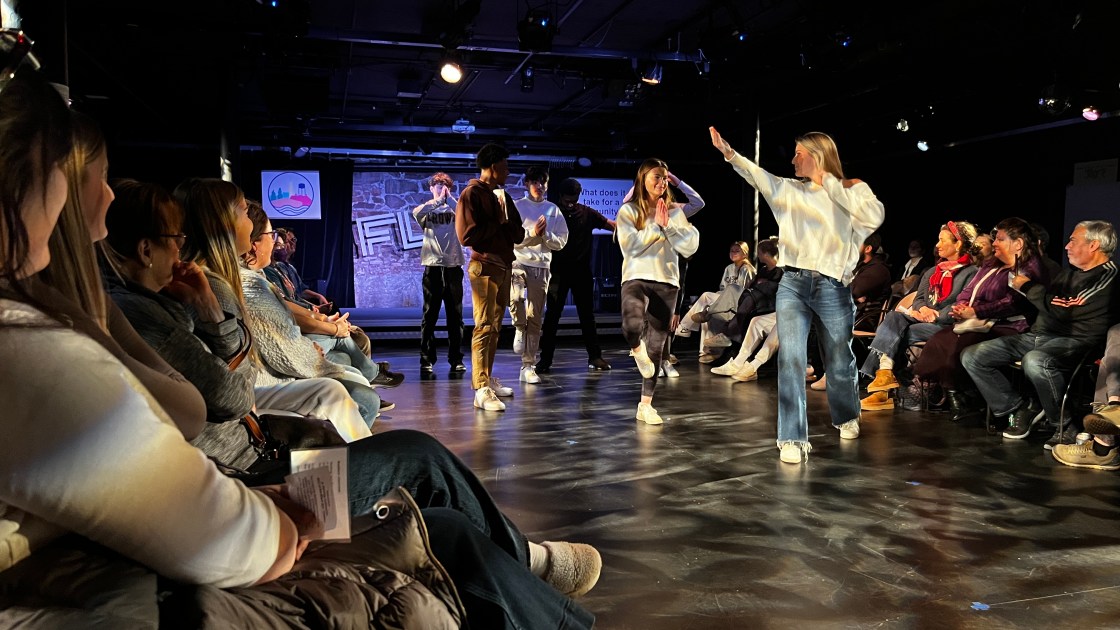
Gina is a longtime teaching artist with the Flynn, and helped us nurture a new partnership with that keystone Burlington institution. Thanks to support from the Flynn’s Education Department, BCL13 had the opportunity to perform in the FlynnSpace – the Flynn’s iconic black box theater. In late September, students visited the Main Stage, got a backstage tour, and began to envision what it would be like to use the FlynnSpace.
At that point, we were a long way from designing an actual show, so we began where theater artists begin: with physicality, silliness, and open-ended play. Within minutes, the ice had been broken, and a student group that was still building trust and connections with one another looked like a seasoned improv troupe.


At the Flynn we got to walk around the building. We also got to see this room that I had never seen before and got to play and act in it. Of course, my group won the acting contest.
The Flynn has entertained people for generations. It gives adults and children joy. Without the Flynn, people probably wouldn’t be able to meet their idols or musicians and other people around the world. This gives people the chance to see other people do their work. Vermont is not a very big place, and allowing Vermonters to see big people excites them. For example, John Lewis came to Flynn and talked about the history of racism and about his own past just before his death.
I liked how the class got the chance to act out and goof off for a little bit. It was also really fun to learn about the Flynn and its history. Learning about it makes me very curious about the future ahead of us.
- Lazizi


Over the subsequent weeks, students spent many hours with Gina and Delanté Keys, Visitor and Guest Experience Coordinator for Shelburne Farms (when he’s not working as an actor/director/social change activist). Early activities sparked students’ creative flow: students wrote abstract postcards, created physical vignettes, and harvested meaningful reflections from their journals. Over time, a concept began to take shape. With Gina and Delanté providing both inspiration and guard rails, students took more and more ownership over what would soon become an immersive, interactive theater experience.


During the past few BCL classes with Gina and Delanté, it has become apparent to me that I do not do enough critical creative thinking in my day-to-day life. The past few classes have challenged me to think deeply and creatively about what I want our show to look like with very little structured prompting. Sure, we have synthesized many of our experiences to use as content, but the most difficult part has been developing our own structure for this performance. In doing this, I have found that it is not a current strength of mine. I know that exercising my creativity is going to be important with whatever I do in life so this was an important wake-up call.
- Ale
Over the last couple of weeks, we have started to work more closely with Gina to create our own performance. I am still not totally sure what we are doing, but something that we seemed to figure out is that the performance will be interactive. In an article about immersive theater, I read that “We know that Shakespeare’s audience would have interacted with the performers.” Today, people are expected in almost all places to be quiet while watching movies or theatrical events when in the past this was not always the case. Working with Gina, I know see that our performance might not just be a “play,”but could use the crowd’s ideas, and integrate ourselves into the crowd.
Performing in front of lots of people seems scary, but this new type of performance where the whole group is working together to make a picture seems a little less scary. It also seems more interesting. Creating this play is exciting, and gives me a better sense of theater and the different ways it can be perceived.
- Miles
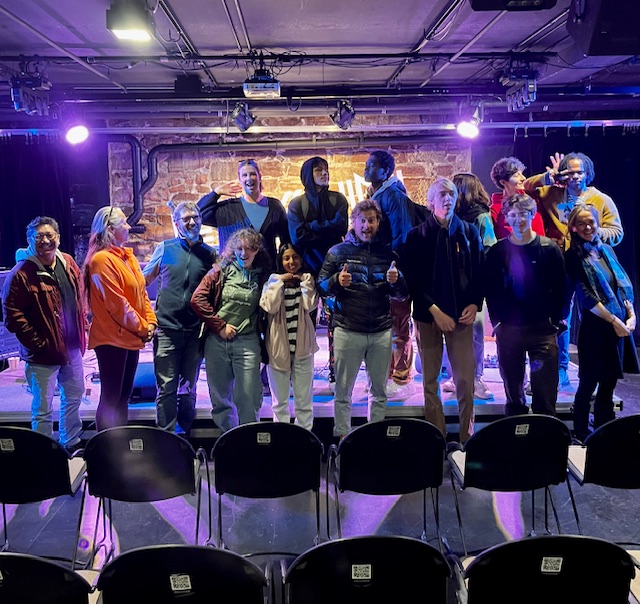
I liked seeing everyone’s different perspectives on how we should create the show. In the end, we incorporated everyone’s ideas to the play. My poem ended up being part of the show, and I felt lots of people liked it. It was a great community bonding experience and I feel I know my peers more now.
- Jacques
I thought the process of creating our show was very special. Not only did we create a wonderful piece of art, but it was based on our community through the last couple months. The audience seemed to be impacted by it and seemed like they enjoyed it. I also really enjoyed all the team building activities and theater games we played as a group. The final piece ended up feeling very different from the other performances I’ve done in the past. It felt very impactful. It was much easier to perform when the audience was more comfortable and more reactive. I loved the audience participation aspect of the piece.
- Kuba
To be able to create the performance was amazing. I liked how we could take our BCL experiences and bring it into the play for the audience to see. I hope the audience learns more about BCL and what it is from this whole experience.
- Josh
In the weeks leading up to our performance, students explored a broader question: How does art help Burlington thrive? Students visited the Burlington City Arts Gallery, experienced a tour highlighting public art throughout the city, and spent an afternoon at S.P.A.C.E Gallery on Pine St. Every encounter added richness, and broadened our understanding of this vital element of Burlington’s identity. This citywide exploration ended at the FlynnSpace, where a short two-day “tech week” forced the group to synthesize, craft, and polish, in time for a performance the following Monday.


Spending the afternoon touring BCA and the greater downtown area, I was left surprised with just the amount of beautiful murals and general pieces of art there were besides the ones we stopped by to see. I can admit that before then I had little to no idea that these pieces were scattered everywhere, let alone feel attracted and have a connection to them. I know that Burlington is a very art-centered place, but I still do think that there isn’t enough emphasis on the ones that aren’t on the front page, as they can have a deeper connection to different individuals then you might think. Essentially, I was left with one question — “ Why aren’t these murals and beautiful works of art not emphasized more, as they can give us hope and enlightenment?”
- Remy
Art is a great way to raise awareness to a situation and get a message out. It can be very powerful and stick with people. When we looked at art in the BCA gallery, a lot of the time I didn’t understand the message of it, but because of that I was able to interpret my own meaning… I think is really interesting, and shows how much of an impact art can have on different people.
It is really important for a city to have lots of meaningful art in it. I also think that there should be more opportunities for students to do art in school because I think that it could be beneficial in many ways such as mentally and emotionally as it can give students a place to express themselves.
- Ruby
During my time at BCL, I became interested in graffiti and murals. For my first Inquiry project, I looked at graffiti in Burlington, but for the next two projects, I chose to focus on murals. I think murals are much nicer to look at, and I believe they are a great way to bring the community together. Murals can make a place look better and often show something meaningful that brings together our community.
Art and social change is when art is used to bring attention to problems like unfairness, racism, and climate change. It helps people see issues in a new way, encourages action, and gives a voice to those who are often ignored. Art can unite people, start important conversations, and show how change happens over time. It helps make society better and fairer.
- Josh
Burlington’s present public art is a combination between the past and the future. For example, the city murals— recently completed in the Old North End— help create a sense of belonging and foster conversations around community, identity, and transformation. As Burlingtons public art spaces evolve, the tension between preserving history and adapting to modern needs grows. The removal of the controversial Church Street mural, for instance, raises important questions about the balance between artistic expression and community response. I think this shows public art can serve as a point for debate. Art reveals deeper divisions in the city’s values and vision for the future.
As I think about the present, I see public art as a crucial tool in addressing current societal challenges, especially those around equity. Public art isn’t just about beauty or graffiti—it’s also about representation. The murals and installations that line the streets of Burlington are a reflection of the diversity and inclusivity that we strive for as a community. The value of public art today is in its ability to open room for disscusion and dialogue. Art can also provide space for marginalized voices, and challenge the status quo.
- Quinten


In our time at the SPACE gallery, many things came back to me. Being immersed in that place full of art brought back some of the artistic spirit I used to have. It unlocked some memories that I had forgotten about, and in our journaling group, I was writing up a storm. I transcribed it all from my journal:
“Art is something that I appreciate and it adds beauty to my day. When I was younger I used to be a lot more creative. I would write stories and draw. I even wrote a book and had it displayed in my elementary school’s library. In Burlington, art adds beauty and also raises awareness to issues like BLM. I think that the city is working towards making public art more inclusive.”
- Pramudita
Our time at the gallery got me thinking about how much I wish I had been more involved with art when I was an underclassman at BHS. I feel like there are so many things I could have learned and experienced if I’d made the effort to check out more local art events or taken classes that were more connected to the community. I am taking my second art class this year which has been so much fun. I will definitely encourage others to get more involved at a younger age.
- Jo
For me it was really fun to have a creative experience. In the studio, we looked at all the miniature art that was hung on the wall. We played a game of bingo that highlighted our favorite pieces, as well as making snowflakes and using a yarn gun. This experience made me think about how important art is to communities and how we should be integrating art into schoolwork as well.
Some of the artists such as Nikki and Noah shared their space with us which is a public art studio that displays public art work for sale… I love how anyone can have their art displayed, it makes Burlington a closely-knit community. The amount of work that these artists put into their pieces is so inspiring to me. They care about beautifying our city along with advocating for important change.
- Annabelle
One thing we talked about at the gallery was places that don’t have art. You don’t realize that certain places don’t have art until you are in that place and you are suddenly walking around for hours and you can’t find any. What is great about Burlington is that you don’t have to worry about finding art, but instead, it is everywhere you walk, you don’t have to walk around and search for it, it just comes to you.
- Quinn


One artist at S.P.A.C.E. who stood out to me was Noah O’Leary, a fiber artist who creates custom rugs using a tufting gun. Watching Noah use the tool to punch acrylic yarn into fabric was fascinating, and he even let us try it ourselves. This hands-on experience gave me a deeper appreciation for the time, effort, and skill behind each piece. This experience highlighted the power of art to connect people, spark conversations, and celebrate diversity. It also reinforced the importance of accessible spaces where local artists can thrive.
- Winslow
I had some time to talk to Nikki Laxar about how having so many different artists really shapes the space. I thought that was really interesting because I didn’t think about how all the different media also reflect the person. In her bio on the SPACE gallery website, she said. “I really enjoy building connections and community, showing and sharing work.” This really just made me feel grateful that there are so many different communities in Burlington making sure everyone feels included. I wasn’t even expecting to talk about community, but BCL has helped shaped my mind… I now realize that something I wrote in my journal is true: “Everything leads back to community.”
- Belle
If creating and experiencing art is the best part of my day, why wouldn’t we try to implement the things we love into other aspects of our lives. Why shouldn’t we try to imitate the good qualities? Art brings the artist’s emotions, ideas and spiritually to life. Some pieces bring a playful and joyous quality… I saw pieces that filled me with joy when I looked at them. Most of them had bright colors or different textures. With that information to increase the quality of my life away from creating art, adding things such as bright colors improves my day.
- Sophie


It was so good to see everything that we’ve done come together. I have never been in theater before so this being my first time was a great introduction. I was nervous at first, but once I got up and said what I needed to say, I felt very confident. I also really appreciated how everyone had an important role and because everyone had an important part, and the final product was great. Performing the play was also awesome and really unique. This is due to the combination of stress and confidence whilst talking. I tried my best not to mess up a line but it was a good feeling to know that the audience didn’t realize it at the time.
- Joshua
After meeting with Gina and getting our performance started, it was really cool to see how we can use art to show what we have learned and taken away from BCL. At the start, I was not expecting us to actually be able to put it all together…
On the day of the performance, I was not expecting to see so many people but in the end it really was not that scary. It was also really cool to show all the work we have done this semester, and people’s responses were so great. It was very interesting creating a play, and how so much goes into it. I really enjoyed the experience. So many people came up to me saying how much they were inspired and how much they loved the show.
- Glenna
I think it was overall a great learning experience, working with people like Gina and Delanté were an amazing boost to our creation. I loved how we came together towards the end when the show was gonna start. through all the laughs and mess ups I feel like it was worth all the effort. I think it was an overall great show, I liked how we came together and performed. Through all the laughs and mess ups I feel like we stepped up when we needed to. I’m so happy that we all ended it off on a positive note.
- Gaston
Public art matters because it brings communities together. It can improve mental health within a community, making everyone involved feel better. For example, there was a story covered by WCAX about a mural right outside our building. A fence post had been tagged with graffiti, but the neighborhood came together and transformed it into a mural of a cat. The cat in the mural is the neighborhood’s “mascot,” and it helped foster a large sense of community among the residents. The hope is that this mural will discourage further graffiti in the area.
If we can create a space where the community is strong, we can address larger issues like homelessness, drug addiction, struggles with alcoholism, and challenges related to food insecurity or getting to school on time. A strong community makes it easier for people to ask for help, as they wouldn’t feel isolated or afraid. When people are in better spirits and working together on a common project, it can also help heal any past conflicts. I believe that public art, especially when it involves residents in its creation, can have a significant impact on our community and could be a step in the right direction toward addressing these challenges.
- Gus
 Burlington City & Lake Semester