
Because in trying to articulate what, perhaps, joy is, it has occurred to me that among other things—the trees and the mushrooms have shown me this—joy is the mostly invisible, the underground union between us, you and me, which is, among other things, the great fact of our life and the lives of everyone and thing we love going away. If we sink a spoon into that fact, into the duff between us, we will find it teeming. It will look like all the books ever written. It will look like all the nerves in a body. We might call it sorrow, but we might call it a union, one that, once we notice it, once we bring it into the light, might become flower and food. Might be joy.
- Ross Gay, The Book of Delights
Joy is one of the key values of the Burlington City & Lake Semester Program. It manifests in the laughter we share during Fun Blocks, the conversations we engage in over our potluck lunches, and our lively engagement with our community partners, young and old.
Our BCL13 Honors cohort listened to the 2019 On Being interview with writer Ross Gay, and read several of his poems. They then took part in a Harkness discussion about his exploration of joy, and what it inspired them to think about. Gay takes joy seriously, knowing how vital it is to our survival, relationships, and communities. He explores joy not only through his poetry, but in collections of essays, including The Book of Delights.
Joy, according to Gay, is never simple, but comes with a recognition of our mortality, and how everything is temporary. Joy acknowledges that the present moment is all we really have, and that this truth connects us to each other in delicate and beautiful ways. For a teacher, the opportunity to listen in as our students grapple with big ideas, offer questions, and share their stories and perspectives with each other-making visible the “underground unions” between them- perfectly fits Ross Gay’s definition of joy.
In the following poems, students express the joys that come from the animals, activities, and places in their lives.

Sunlight – Kuba Thelemarck
Sunlight stretches its arms across the horizon along with the earliest risers
The rocks and logs beam with gratitude
The mossy knoll pulled from its slumber
The great oak smiles with recognition
Sunlight peers through the foliage
Catching glimpses of chipmunks who reside in its heat
Sunlight flows silently with the nearby creek
It dances with the ripples until the sky grows quiet
Sunlight waits for the new day
Ready to unite the structured and the wild under its cozy glow

A Sunday Morning – Remy Dietschi
It begins with the scratches at the door.
Then the howling, sharp and rising,
A sound that stirs something deep.
I don’t mind.
No rush, no haste—
Sunday mornings stretch wide and quiet,
The scent of fresh coffee reminding me of the journey ahead
The woods wait for us,
Damp earth, sunlight fractured through pines.
Her name calls out, and she leaps,
Muscles coiled like a bowstring,
The air crackles in her wake.
I hear her bursting through the trees,
Leaves shiver, twigs snap—
There goes Goose.
The chains of her collar and my stress, are gone
The morning calm fills my chest.
Before this, there was only the weight—
Thoughts pressing heavy,
Like stones stacked too high to see the sky.
But now, her wild joy pulls me forward,
The ache lifts as we run.
We wander far, but never lose each other.
Her fur brushes against my hand,
Not a prize but a promise,
Soft and grounding as the earth beneath us.
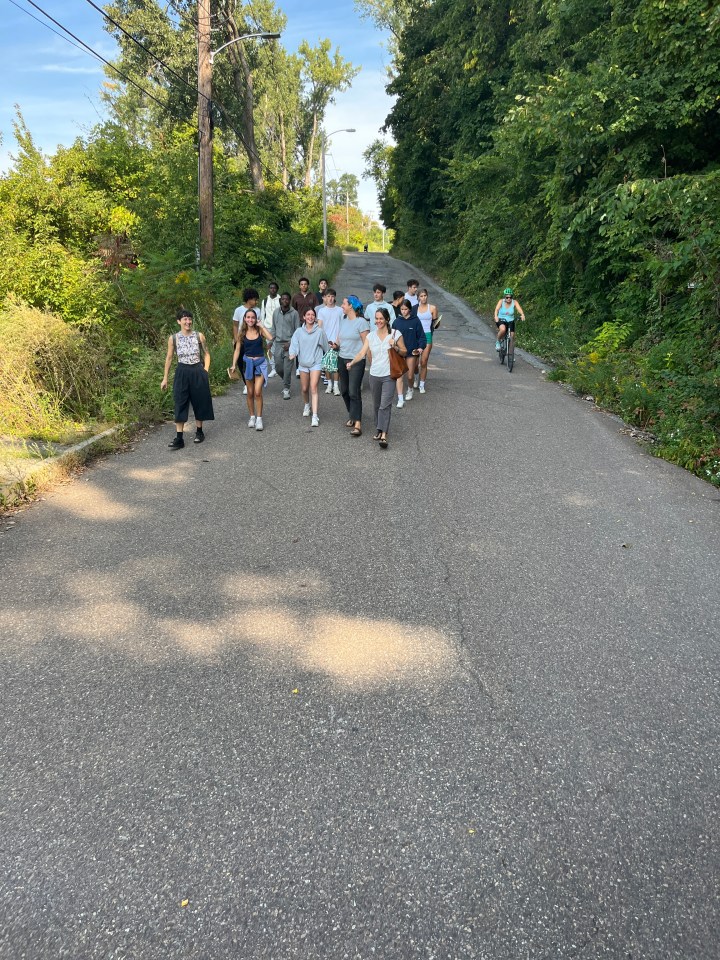
Our Map – Ale Dietschi
We begin with our map of Burlington,
Where streets whisper their stories
To our curious minds—
Allen Street, the heartbeat of our class.
Home of the O.N.E. Community Center.
Here, we trace
The veins of a city:
Church Street, where commerce meets our community,
Pine Street, a passage of creativity, art, and enterprise.
These streets carry the pulse of Burlington.
Where the souls of systems – housing, food, transit –
Are in our hands,
And questions burst like seeds
From our journals:
“What does community look like?”
“How does a community thrive?”
“How can I help?”
We leave our mark on the banks of the Winooski,
where roots anchor stories
of equity, of resilience.
Our newly planted trees in the Intervale
will someday reach for tomorrow’s sky.
Our conversations bring forth invaluable questions with partners:
The Community Sailing Center,
Seven Days journalist Courtney Lamdin,
Urban park ranger Neil Preston,
The Intervale.
Our collective ideas looking to better our city.
This semester – our cycles of inquiry,
our connections and questions –
have turned our classroom inside out,
making Burlington our canvas.
A city carried not just in our minds,
but in our hearts,
pulsing toward the lake.
What a map we’ve made.
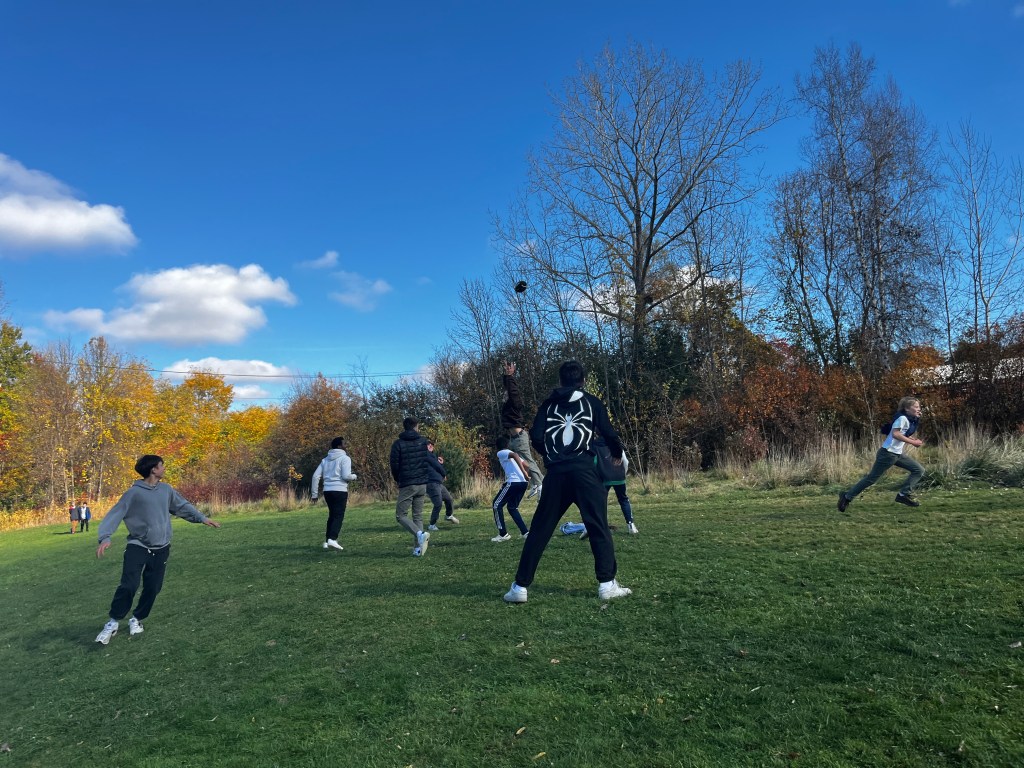
The Love of My Sport – Lazizi Joseph
Football, a sport that I love to play,
Where people tackle each other,
Getting angry, hyped,
Like a demon coming after you,
Injuring themselves on the field.
In the stands, crowds cry out,
Standing there,
Getting pumped up.
Coaches yelling at the players to do their jobs,
While worrying if they’re going to score.
Players on the field worry
That they’re going to get hurt,
Or if they’re going to do their job right.
This is a feeling of football.
The joy of stepping on the field,
The joy of playing a game.
The joy of giving my all,
Even in all the pain, I still stand tall
This is the sport I hold dear,
The pain I cherish,
A game where boys turn into men.
My love for the sport is endless,
No other can compare.
But as soon as my body starts to fail,
Legs trembling, heart aching,
Head spinning,
I know I can no longer play football.
A sport I love so much,
Seeing fans cheering,
It will finally come to an end.
Football doesn’t last forever for everyone,
You’re no longer just a player,
You become a legend.
Seeing your name on the Great Wall,
Finally knowing you’ve gained back the love
From the sport you cherished:
Football.

What Matters – Gaston Ngoma
The basketball, A smooth, familiar texture. The rhythm of the dribble, a comforting percussion against the asphalt. A clean shot, nothing but net. The satisfying echo in the empty court.
The warmth of family. A shared meal, laughter echoing around the table. Inside jokes and comfortable silences. The feeling of belonging, of being truly seen and loved.
The quiet satisfaction of a job well done. The steady accumulation of resources. Not for greed, but for the security and opportunities it provides. The power to build a future, brick by brick.
The gentle act of caring. The hand on a shoulder, a word of encouragement. The knowledge that even small gestures can make a difference in someone’s life. The quiet joy of lifting others up. These are the things that matter.
Walking Home – Quinten Savelberg
Each step lands softly,
pressed into the damp sidewalk,
where fall leaves cling like stamps on a letter,
crinkling underfoot—a symphony of crispness.
The air wraps itself around me,
cool and sharp, like it’s looking for a way to sneak through my jacket.
The smell of damp wood and fading smoke
from chimneys that puff like mighty steam engines.
Shadows stretch long as night approaches,
And the afternoons are short,
the light slipping away too fast,
a cruel reminder that the day is nearing its end.
streetlights flicker awake,
casting light on puddles that mirror
a sky slowly dimming to ink.
The glow from all the lights on North Avenue catch my eye,
the sound of traffic wakes me up, as I turn down West Road.
In the distance, a dog barks,
its echo bouncing between lit-up houses,
where curtains glow yellow,
hiding lives I can only imagine.
The faint light of a car drifts by the farther I walk,
its wheels hum over the asphalt.
I wave at its taillights,
though they never wave back.
My backpack shifts with every step,
zippers bouncing back and forth,
the weight of school and the day’s worries
hung across my shoulder,
but growing lighter with each passing house.
I am alone with my thoughts.
“I wonder what’s for dinner”?
By the time I reach my door,
the night has pulled its blanket tight.
The world whispers goodnight,
and I’m home.
 Burlington City & Lake Semester