Most students know the program by its acronym: “BCL.” In those letters are a key goal of the semester — to help learners feel more connected to both their city and their watershed.
Over the years, we’ve learned that young people can’t care for a place without caring about a place. It starts with spending time out in the world. Once we have a relationship with neighborhoods, urban wilds, beaches, and lake, then we can feel like stewards. Each semester, Burlington City & Lake Semester students deepen their relationship with both water and land, and the result is a renewed desire to take care of the place we call home.


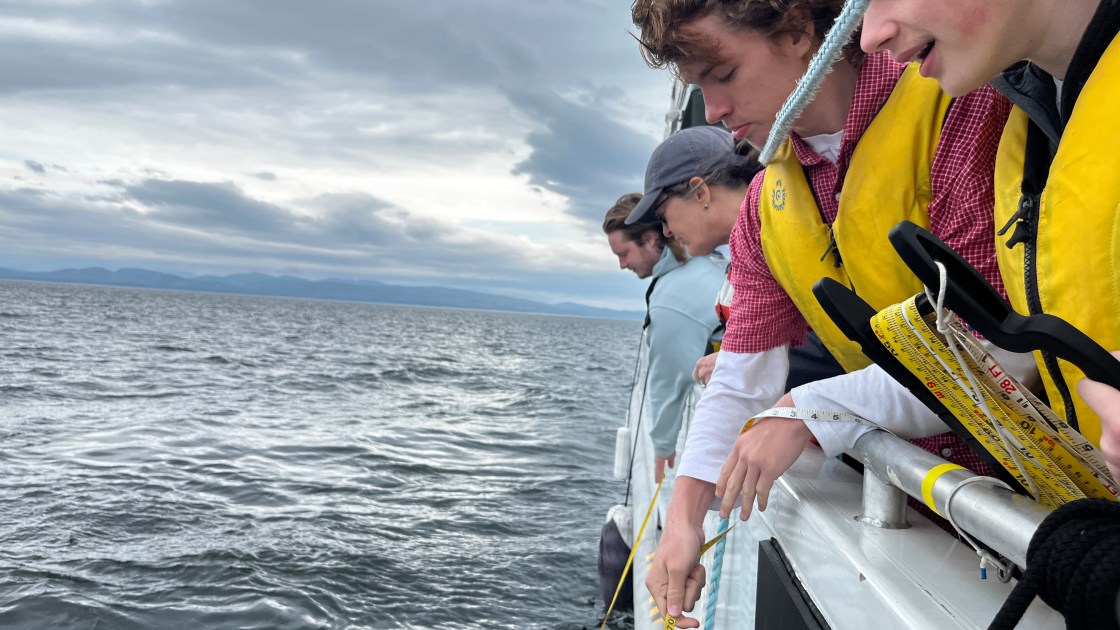
Being on the Melosira was exciting because I had never been on a research vessel before.
- Tyler
It was fun to go out and see how they use their equipment to see how cloudy the lake is. I loved being able to lower the secchi disk into the water and measure how much light filters down. Talking about microplastics also made me wonder about how much the fashion industry affects the water around the world.
- Jude


I feel like I already make a lot of my consumer decisions based around sustainability. I stop my friends from littering a lot, and I try to buy my clothes primarily secondhand. Looking for microplastics in our water samples just reinforces those things.
- Harper
On the boat, we thought about how to help the lake. I’m thinking about what I can personally do to help the watershed, like to be more wise about my choices, to not to the single-use plastics like water bottles, to always pick up after myself and leave places better than I found them. If lots of people make small changes, the lake’s health will be much better.
- Finn


I really enjoyed mentoring the kids, they loved talking and I think they liked how goofy I was being. They did a good job listening to me and getting the task done, so I’m proud of my little group. I think it’s important for young learners to have experiences in nature and do nature based projects because it connects students to the world around them.
- Amelia
Our time on the research boat was similar to the tree planting we did today. This is because on the boat we were able to learn about our responsibility to the environment and today we fulfilled our responsibility to an extent by planting a pocket forest. The project was great. I think that it was a lot more engaging for the 5th graders, and I could tell that they truly enjoyed making a difference. I also think it was awesome to lead my own group and work on my leadership skills.
- Eli
A connection between our time with the UVM research boat and our time planting with kids is how we should care for our environment. In the lake we want to preserve all the native fish in the lake and on land we want to keep native trees and plants healthy as well. Another way they are connected is both can’t be done alone and won’t change over night, they both take many people and time.
- Quinn


Having experiences in the natural world is important because we need to connect with the Earth that we live on and provide care for it–instead of being online and social media. It is also super important to plant trees instead of grass. On the UVM boat, we learned that trees help soak running water.which can help stop polluted runoff water from entering our lake.
- Byron
The boat and the planting project have a connection. Both experiences are very nature oriented. And both include an effort to help fix nature after we have damaged it. With the boat, we researched the water and how it had a lot of invasive species and microplastics. And planting trees was like us trying to make up for that.
- Thomas
Both experiences connect to learning in nature, about nature. On the melosira, we learned about the ecosystem of the lake. While planting the trees, we learned about how they can survive in certain environments, and helped them get in one they can today.
- Jimmy
A connection between the Melosira research boat and our time planting trees is that the people we were working with all seemed very passionate about what they do. They all seemed like they really actually wanted to make a difference in the world. In both of these places, they also saw something they didn’t like and worked hard to solve problems. On the boat and with the kids, our actions alone make a big impact, especially once it’s all of us together.
- Nasra


 Burlington City & Lake Semester