For the 2024-25 school year, Emily Taylor served as BCL's Place-Based Education Teaching Fellow. To read more of Emily's reflection on her growth as an educator, visit the Shelburne Farms education blog.
INTRODUCTION
The first time I formally taught was in an undergraduate lab section for a freshman seminar at the University of Vermont, called Natural History and Human Ecology. The professors prompted me to write a teaching philosophy. I wrote:
As I have grown into teaching, it is clear there are certain values at the forefront of my methods. I believe that agency, connection, and curiosity guide learning, and my teaching should be guided by my understanding of these. Creating healthy challenges in each of these areas is an objective of mine.
I look at this now, and see that I was always meant to be a Teaching Fellow in the Burlington City & Lake Semester. This program gave me the tools and experience to further explore these values and beliefs. It felt completely serendipitous that my own guiding principles aligned with the BCL program. If agency, connection, and curiosity are re-worded slightly, they easily become empowerment, community, and inquiry.
For months, I have had to explain my job to strangers, interviewers, coworkers, friends and family. It is not easy to capture the program in a couple of sentences, and it is even more difficult to capture what I have taught, what I have learned, and the gratitude I feel.
Teaching two semesters of BCL has brought ups and downs, experimentation, growth, adaptation, challenges, and success. There is no better way for a trained scientist to explore this experience than in the format of a lab report. It will help my brain categorize and make sense of nine months of learning. I hope you enjoy following along.

MATERIALS AND METHODS
Any solid scientific paper starts with the methods and materials of the study. This experiment spanned two semesters, Fall and Spring, which in Vermont, was a winter semester. There were 38 students, 22 in the fall and 16 in the spring, two semesters, two Crews (shoutout to the best Crews!… Duh), two co-teachers, and two artists in-residence. I spent two-ish days a week at Shelburne Farms collaborating with their education team. Outside of BCL, there were also many connections to and collaborations with UVM’s Place-Based Education Certificate Program, the Rubenstein School of the Environment and Natural Resources, and partners from the greater Burlington community. Add to that dozens of BHS sports events, a production of Matilda, community events, and much more. The problem with this Materials and Methods section is this: this experiment is not replicable. This results in scientific findings that are based on my unique experience and perspectives alone. So this lab report will not be perfect science but completely true anyways. You have been warned.
This experiment is not replicable because there will be no other Emily for this program and there will never again be groups that match BCL13 and BCL14. And this IS NOT because Emily is the best or because BCL13/14 are the best either (although we are all pretty awesome). This is because every unique individual that makes up a BCL community brings their life experiences, perspectives, interests, and individuality. That is half the magic.

RESULTS
I have found that my lessons and best “results” fall into three different categories. We often tell students to take risks and to be vulnerable, knowing that they might fail or need to ask for help. It wasn’t until I started practicing this myself that I found myself learning from failures. I call this category “Learning Through Challenges”. Then there are the magic moments where the work all comes together in meaningful, deep learning for students. In these moments, one feels the importance of their work and validation. I titled this category “Learning by Impact”. Lastly, there is the category of “Learning Through Balance,” which is an internal feeling. For some time, I grappled with imbalance, before coming to experience and understand true balance.
Learning through Challenges
I am a young teacher. When I started, I was brand new to working with high schoolers in a classroom. I am also awesome and fun (humbly), meaning students wanted to connect with me relationally. I had to navigate both my role as teacher and my role as near-peer. They would remind me of my proximity to them in age, pointing out the difference in age between myself and my co-teachers as well. There were comments about my not being a real teacher, about the fact that I was only a “student teacher,” and about not needing to take me seriously. I looked for the positive, the spin I could put on my unique circumstances.
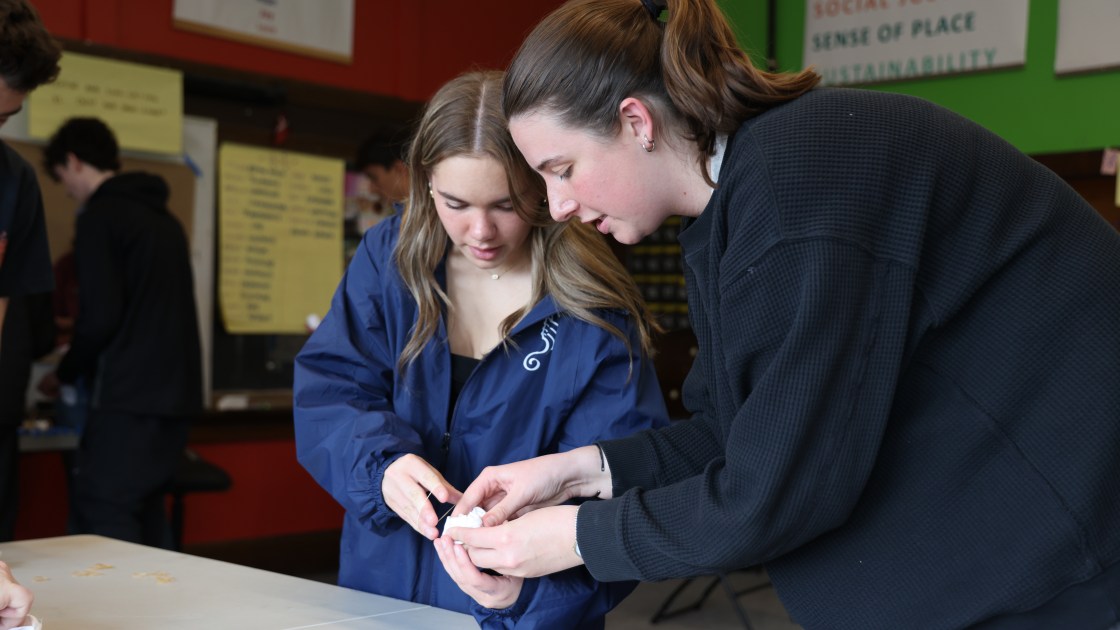
I continued to work on setting firm and community-based boundaries in the classroom. As I began co-creating boundaries with students, I observed them developing a sense of agency and deeper understanding for the boundaries. The boundaries were important, but so was their agency. When I asked students for feedback at the end of the year, they noted that they often felt like I gave them options on how to carry out a task. This was great to hear, and affirmed that I was reaching certain goals I had set around that agency. Setting boundaries and offering choice actually came from my time at Shelburne Farms in my other capacity as a teaching fellow. Working with younger students requires more clarity in delivering instructions and close attention to your wording. Flexing this muscle each week with 5-8 year olds was essential for learning how to practice the same skills with high schoolers. I learned that setting boundaries made me more “teacherly.”
Through my time at BCL and with further reflection, I came to realize that my age was not a liability. Rather, it was a gift that allowed me to position myself in the classroom as a near-peer – someone who could listen closely, relate to students, and ultimately understand them in ways that made them feel more seen.
Learning by Impact
In many small moments with the Burlington City & Lake Semester, I could see students changing and growing. I recall a moment in the fall when one student took a moment to deeply thank another for their energy and inspiration. They were not tight friends, but nonetheless, our community created a space where one student could see and shout out another student. They were also not afraid to say it out loud and in front of all their peers. It was a true moment of love.
Other times, moments of change and growth spanned the whole semester. This was easy to see when I was grading each of their Expos (a core BCL writing assignment) and watching students use and apply the feedback that I offered. But it is even better to hear at the end of a semester from a student when they sit down for their one-on-one Evidence of Learning meeting. Each story they told of their own growth was deeply reflective and perceptive and allowed us both to see the whole picture.
I have had a hard time focusing on the specific things that I did that allowed for change and growth to happen, but I know that I had a hand in it, and that feels important. In my head, it boils down to offering consistent feedback, knowing the students well and deeply, and identifying how much support each student needs and then offering even more. I like to think I brought a bit of natural talent to this.
Along with being a relatable near-peer, I am also a listener by nature, friendly and approachable. I am someone who can help students feel truly known and seen. Sometimes this takes a lot of extra work. Listening is step one. For me, taking notes during meetings or observations was step two. Over time, I grew equipped to almost memorize things that students shared. Often this created moments of surprise when I would reference something students hadn’t realized that they told me.
Relationship-building is a patient practice, and there is always room to be better. So I tried to keep getting better. I showed up, going to sports events, AP art gallery openings, theater performances, and senior Personalized Learning Plan meetings. I practiced vulnerability in sharing about who I am as a learner, the challenges I was having as a new teacher, and life moments, both celebratory and difficult. I was excessively, almost annoyingly, proud of small wins for students, trying my best to hype them up at every moment possible.
I asked for authentic feedback and support from both students and co-teachers. And I got better, and learned, and adjusted in real time, to continue getting better. It is so amazing to me how simple “practice makes progress” is. This role was the perfect place to improve, practice and hone my skills.
Learning through Balance
The incredible program that is Burlington City & Lake Semester is a balancing act. We balance experiential learning with traditional academic goals; we balance reflection (cognition) and serious empowering work with fun community building. I also balanced my near-peer and teacher role, knowing when to speak up or sit back on a teaching team, and when to overplan an experience or just plan for emergence. Often an imbalance is easy to identify, but knowing how to create the conditions for this balance is more difficult. I have been told that teachers make a thousand decisions a day on the fly. Before this year, that was not a skill I had, but one that I am now growing into. Creating the conditions (and making the decisions) for that magical balance is a skill I am still working on, in all honesty – but what I have now is a toolkit.

DISCUSSION
In BCL we often push our students to ask SO WHAT? What is the relevance and the impact? In this case, the question is: Why even have a Teaching Fellow or a “learning teacher”?
Will she even continue teaching?
I am happy to report that following this year, I know undeniably that I want to work with teenagers in some capacity for the rest of my life. I cannot tell you yet if the setting is a classroom, but it most certainly is as an educator or a mentor. I feel called to keep helping students understand complexity and interdisciplinary topics. I want to continue to empower students in their learning and provide agency and curiosity, however that might look. It will be different for each student and every student, and each of them deserve the space and individual attention to nurture their interests.
Before teaching at BCL, trees and frogs had alway been enough for my students, which is not always the case for “city kids.” Having a relationship with each and every student is the only way to best know how to cater to those differences. I know that this will be the hardest to replicate wherever I teach next. There is nothing quite like the ratio of 1:7 in most public high schools. The building of community within a classroom at BCL is unlike anything I have ever experienced before. It is hard to quantify and explain how exactly it happens, but it certainly takes a lot of work. It requires attention to team building, being vulnerable, presence together, trust, fun, and love.

CONCLUSION
I hope to leave my teaching philosophy that I wrote three years ago as an archive of the educator I began as. I imagine this report will be a helpful starting point for writing about the educator I am now. Someday I hope it will become an archive itself. Looking forward I hope that continual growth and learning are the only constant.
ACKNOWLEDGEMENTS
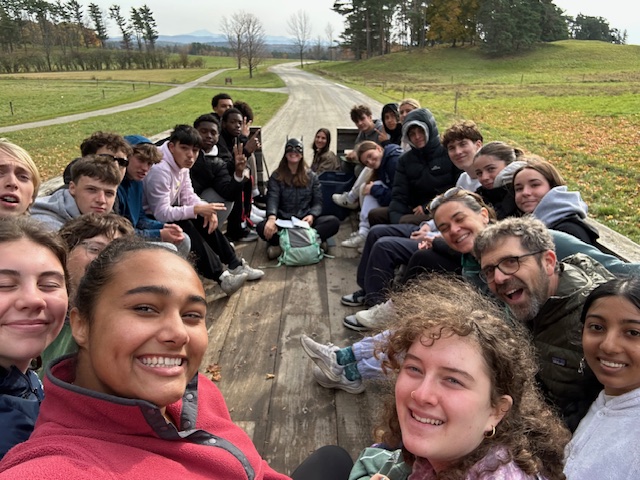
Where and how do I even start to thank everyone adequately? To all the students from BCL13 and BCL14 – you have profoundly impacted my life. You have taught me so much more than I could ever synthesize. I already cannot wait to see all the epic things you do, the communities you build, and the ways that you will empower people around you.
To Dov and Christie, thank you for believing in me and supporting me in every way. Thank you for your deep collaboration and mentorship. You are truly fantastic educators, and I have gleaned many tools and skills just from watching you. I have also learned so much about working on a team and the flow between teachers that is possible in a classroom with three. Thanks for hyping up all my niche interests and also poking fun at them. But FYI – watching “too much reality television” is what I would call analyzing modern sociology, group dynamics, human behavior, and cultural anthropology. I digress.

Aimee Arandia Østensen has also been so helpful in guiding me through my first year of teaching. There are so many things about teaching that I never knew I would need help understanding. Aimee made all those moments much easier, offering feedback and suggestions, helping design curriculum, new tools to try, books to read, and most importantly, offering lots of encouraging words and reminders. I only hope I can spread the sparkle she gave me.
 Burlington City & Lake Semester