
Written by Christie Beveridge
When I began teaching high school English, I was newly graduated from college, chock full of information and knowledge that I wanted to share. A combination of this excitement and my nerves about managing a classroom as a young teacher meant that the students in my first months of teaching heard a lot of my voice- from my instructions on what makes for an effective essay, to my passion for the stories, plays, and poems we were exploring. What I soon realized, however, was how my voice was overshadowing the most important voices in the room: those of my students, who had wisdom, perspective, and insights to share, insights about texts that I thought I knew inside and out.
Over time, I gradually became more comfortable facilitating student discussions; soon after, I let students run the discussions themselves. The result was a revelation. Students who before had looked to me after speaking in class to affirm that they had the “right” answer began sharing their ideas with their classmates, who would build on their point, or disagree, or remark on how their insight had changed their own thinking. With some coaching, talkative students would temper their contributions, and invite their quieter classmates in. Students would arrive at discoveries together, and take conversations in directions I never imagined. They would ask questions, synthesize ideas, and integrate textual evidence into their arguments, all while I looked on, quietly taking notes, and reminding myself that as much as I wanted to jump in and offer my thoughts, this was their time, and my role was to observe.
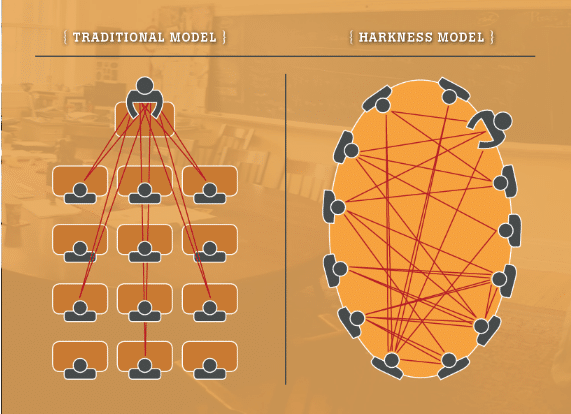
This kind of student-faciliated discussion is known as the Harkness method, and since its implementation at Phillips Exeter Academy, it has become a fixture in many classrooms across the country. It enables students to feel empowered, to learn together, and to practice the real world skill of exploring ideas with each other in person, and in real time. Some hallmarks of a successful Harkness are when there is a balance of voices and air time, ideas are supported with evidence, and all participants treat each other with respect. Active listening is a key skill to bring to a Harkness, as is being prepared with notes and quotations from the text the group is exploring. After a discussion, the group takes time to reflect on what went well, and what they might want to improve upon for next time.
I have been so happy to use this method with the Burlington City & Lake Semester students who have chosen to take the course as Honors. It is an invaluable tool to bring to all classrooms, no matter the subject. In a time when so much of our discourse leads to disconnection, providing avenues for students to discuss and debate ideas together, with respect and care, is essential.
This semester, we have held four Harkness discussions using podcast episodes as texts: an interview with indigenous writer and botanist Robin Wall Kimmerer, an interview with author and activist adrienne maree brown, a conversation about loneliness and connection with Dr. Brené Brown and Dr. Vivek Murthy, and an interview with poet Ada Limón. The following are reflections from BCL15 students about their experiences with the Harkness method, how it is different from a teacher-led discussion, and how they envision integrating the strategies of student-centered discussion into other realms of their life, including future classes and careers.
I really enjoy how the ideas just bounce from student to student. Often when there is a teacher-led discussion, the discussion is redirected by the teacher in the direction they want it to go. Students often come in with less expectations and therefore have a more free-flowing conversation. It also allows the students to be the ones to pull in more voices.
- Miranda
In the real world there isn’t a teacher who guides conversation. Discussion is based among your peers. You must be able to have productive conversations with colleagues in the workplace.
- Sam
[I like that the discussions] are free to go wherever the students want. I think a lot of times students are concerned with what the teacher might want them to say, and in a Harness discussion there is less regurgitation of certain viewpoints in hopes of obtaining a certain grade. Harkness discussions are therefore more authentic.
- Cal
They feel different from teacher-led discussions – we are released as students to learn among ourselves. Being able to talk to other people without a teacher-induced structure will be a great skill to carry into all future parts of my life.
- Jesse
It feels like we can take the conversation any way we choose, and I think it helps us feel more independent and in control of our learning. I have enjoyed being able to work on balancing listening and sharing, and I feel like our Honors group has executed the Harkness model very well. It has been a great experience to hear everyone else’s perspectives and takes on the podcasts and essays.
I think it can prepare me for my future because it helps me to balance my listening and talking skills, and helps me to collaborate with others and hear others’ ideas.
- Harper
Featured image courtesy of Vecteezy.com
 Burlington City & Lake Semester